


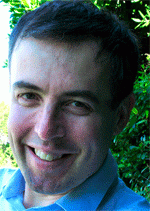

Renee Liang is a poet, playwright, short story writer, and librettist. You can find out more about her work on her excellent blog and in my interview with her almost exactly a year ago.
Renee's latest venture is very timely indeed: a play called "The First Asian AB", which has Auckland and Wellington seasons coming up. Here are all the details from Renee's announcement:
Introducing The First Asian AB, a hilarious new comedy from Kiwi-Chinese writer Renee Liang...
What would you do to represent?
Willy’s a homestay Asian student. Mook’s Samoan and he’s been here for ages. They’re best mates at Timaru Boys High. But when Willy decides his dream is to try out for the All Blacks, mateship — and everything else — is up for grabs.
A warm feel-good comedy with serious undertones, The First Asian AB examines the question ‘what makes someone Kiwi?’ Is it rugby, racing and beer – or being true to oneself and one’s friends?
At breakneck pace, Benjamin Teh (The Bone Feeder, Odd Socks) and Paul Fagamalo (Rent, Where We Once Belonged) capture multiple characters – a Samoan aiga, a bored class of thirteen year olds, two entire rugby teams playing each other, and one sassy girl called George.
Directed by Edward Peni (Samoa Mo Samoa, The West Auckland Cardigan Appreciation Society) with live music by Andrew Correa, and dramaturgy by Oscar Kightley, The First Asian AB debuts as part of the Real NZ Festival (the 'arty' side of the Rugby World Cup!).
Where You Can See the First Asian AB
Basement Studio, Auckland, 6pm, 13-18 Sep 2011,
Tickets http://www.iticket.co.nz/events/2011/sep/faab/, (09) 361 1000
Q+A after the show on the 14th
BATS Theatre, Wellington, 6pm, 22 Sep-1 Oct 2011,
Tickets http://www.bats.co.nz/content/first-asian-ab, (04) 802 4175
Q+A after the show on the 23rd
Tickets $18 full, $13 concession (seniors/students), $15 groups 6+
Renee adds:
For rugby diehard fans: where else could you pay 2% of the cost of a RWC opening ticket and watch 3 rugby matches in 90 minutes?? The show contains plenty of rugby hero moments!!
For people who couldn't care less about the RWC: this is not really a play about rugby, but about the immigrant experience. (Shhhhh.)
10 September 2011
The First Asian AB - Renee Liang's New Play Comes To Auckland And Wellington


08 September 2011
Judging And Presenting The Dan Davin Literary Awards
In April, I took part in the Readers and Writers Alive! Literary Festival in Invercargill, and had a great time. Hamesh Wyatt, Rebecca Amundsen and the Dan Davin Literary Foundation really know how to look after visiting writers - in a way that makes them feel a part of the community they are visiting - and if you ever get the chance to attend the Festival, my advice is: take it!
But my association with the Dan Davin Foundation didn't end there. I also took on the job of judging the Open and Student short story competitions, and I returned to Invercargill on 1 September to present the prizes.
I didn't know it when I chose the winners, place-getters and honourable mentions, but the identity of the winners turned out to be stories in themselves, one sad and one happy.
As the student section winner, I chose "A Day at the Beach" by Pooja Pillay. What I didn't know was that Pooja was seriously ill by the time I made my choice. She learned of her victory the day before she died, a few days before the presentation ceremony, as reported in the Southland Times.
As the Open section winner, I chose "The Journey of the Magi" by Claire Buckingham. While the Student competition is confined to senior high school students from Southland schools, the Open competition is open to entrants from throughout New Zealand, and this appears to have been the first time that a Southlander has won the Open section. (Not that I knew this when judging - the entries were anonymous.)
There were a number of other very fine stories among the placegetters and Honourable Mentions, and as I said in my Judge's Reports, both the present and the future of Southland writing appear to be in good hands.
Given the circumstances, the presentation ceremony (at which Bill Manhire also delivered the annual Dan Davin Lecture) was a bittersweet affair. I presented the open competition awards first - there was a lot of applause at the news a local writer had won, but Claire is away on her travels and wasn't able to receive the prize in person - and the student competition awards second.
This meant that Pooja's award was the last announced, and having announced her as the winner, I then handed over to representatives from Pooja's school, Aparima College. One of Pooja's fellow students gave a moving eulogy that focused on the difference Pooja's presence had made to the school and to her fellow students, then her English teacher read Pooja's winning story before we settled back to listen to Bill's lecture.
Some of us were still chatting away over food and drinks the best part of an hour after the formal parts of the evening finished, and this discussion only reinforced my feeling that the main thing holding writers back in Southland is not any lack of ability, but isolation, both real and perceived. I know the Dan Davin Literary Foundation has some big plans to help ease that isolation, and I am looking forward to seeing those plans come to fruition.
06 September 2011
Tuesday Poem: The Wall, by Tony Malone
The sole guardian of the citadel is he,
the last hope of a billion souls and a billion hearts,
a warrior towering in front of his own Thermopylae -
through him, they must pass.
He stands, waiting, as so many times before,
with the calm of the warrior,
for the approach of the foe…
which comes again
with a fiery catapult
of blazing red
thundering down the pass
finally breaking his resolve,
shattering his defence,
ending his resistance.
The white-clad warriors cheer,
their victory dance mocking the memory
of the heroic struggle. The people roar
as the warrior disappears from view, yet…
In their joy is respect, and the truth that
with the falling of the Wall,
victory is inevitable - and complete.
Credit note: "The Wall" is published here for the first time by permission of Tony Malone.
Tim says: A couple of weeks ago, my Tuesday Poem was Ponting's Genius by Meliors Simms. Meliors' poem was about Herbert Ponting, the photographer who accompanied Scott's expedition to Antarctica, but as I expected, some of my readers saw the title and though that Meliors' subject was Ricky Ponting, Australian cricket captain.
One such was Tony Malone, an Australian writer, reader, reviewer and blogger who, like me, is a participant in the weekly South Pacific and Asia Book Chat (#spbkchat) on Twitter. I told him he was welcome to send me a poem about Ricky Ponting (and he still is!), but instead he sent me one about a cricketer I greatly admire, Rahul Dravid.
England and India have just finished playing a Test cricket series during which England overtook India as the #1 team in the world. In fact, England beat India 4 tests to 0. India were hugely disappointing, and only one of the great Indian batsmen stood up against the English bowling attack: Rahul Dravid, the man they call The Wall. Tony's poem is a fitting testament to his skill and determination.
If you'd like to read some more cricket poems, check out New Zealand cricket poetry anthology A Tingling Catch, edited by Mark Pirie, and the blog he maintains that has carried on the work of the anthology.
You can read all the Tuesday Poems on the Tuesday Poem blog - the featured poem is on the centre of the page, and the week's other poems are linked from the right-hand column.
05 September 2011
October Book Tour To Launch Men Briefly Explained and Tongues Of Ash
It's all on! The Interactive Press book tour for my third poetry collection, Men Briefly Explained, and Keith Westwater's prize-winning debut collection Tongues of Ash, starts in Dunedin on Tuesday 25 October and ends in Auckland on Tuesday 1 November. Here is the tour poster:

For the benefit of Google and of those, like me, whose eyesight is not what it was, here are those details again in text format:
- Dunedin: Tuesday, 25 October, Circadian Rhythm Café, 72 St Andrew Street, 8pm
- Christchurch: Wednesday, 26 October, CPIT, Madras Street, 5:30pm
- Wellington: Thursday, 27 October, Wellington Central Library, 5:30 for 6pm
- Lower Hutt: Friday, 28 October, Rona Gallery/Bookshop, Eastbourne, 6pm
- Auckland: Tuesday 1 November, Poetry Live, Thirsty Dog, 469 Karangahape Road, 8pm
You can also see these, and signal your attendance, on our Facebook events page: http://www.facebook.com/#!/event.php?eid=188416554563635
To celebrate the occasion, Keith Westwater has launched his own website.
Dr David Reiter, the publisher of Interactive Press and a noted poet in his own right, will also be in attendance and reading from his new collection My Planets. As he is an international poetry publisher who has a track record of publishing collections by New Zealand poets, he may be someone you want to get to know.
We will be doing lots more to publicise individual events over the next seven weeks, but if you just can't wait that long to get your copy of these books, or if you live where you can't get to a launch event, you can already purchase both books from Amazon in paperback and Kindle ebook formats, as follows:
Tongues of Ash: paperback and ebook
Men Briefly Explained: paperback and ebook
01 September 2011
Oh, All Right, If You Insist
I wasn't going to. But after spending the past two days reading nothing but pleas from leading media outlets for me to change my mind - "He must tell us!" (New Orleans Times-Picayune), "This has become an urgent matter of national security" (Washington Times), "All Blacks something World Cup something" (Dominion Post) - I have decided to give in. The rumours are true: the three titular brothers of my Tuesday Poem Tres Hermanos are indeed that trio of Hollywood hot-shots, Zack, Jed and Joss Whedon.
Here they are with Maurissa "Mo" Tancharoen at some San Diego Comic Con of distant memory - that's Mo, Joss, Zack and Jed in that order. Since the brothers Whedon got their (uncredited) chance to shine in Tres Hermanos and hence Men Briefly Explained, here is Mo Tancharoen with Fran Kranz in the music video for her and Jed Whedon's song "Remains". It's a video that manages to be beautiful, creepy, sad and feminist all at once.

30 August 2011
Tuesday Poem: Tres Hermanos
They're feudin', Mama.
They're rasslin'.
They're camped up in Bozeman
for the party season.
One is a long bore.
Another raids the mini-bar, now sure
his date won't show. The third
defends his diary with a secret code.
A horseman riding by
observes the niceties of outstretched thumbs
(that poor horse,
sway-backed and spavined,
when all it wanted was a better ranch).
Hear that far-off harmonica blow
beneath that far-off sky.
See that second mortgage slip away.
They're fussin' and a–fightin', Mama,
those three sons of yours,
arguing over the script
as wolves tiptoe behind.
Credit note: "Tres Hermanos" appears in my new poetry collection, Men Briefly Explained.
Tim says: The note about this poem at the back of Men Briefly Explained helpfully advises as follows:
"Bozeman is the fifth largest city in Montana, on the route of the former Bozeman Trail. Though this is not stated in the poem, the three titular brothers are named Zack, Jed and Joss, which irresistibly suggested a Western theme."
Times are tough, even in Hollywood.
You can read all the Tuesday Poems on the Tuesday Poem blog - the featured poem is on the centre of the page, and the week's other poems are linked from the right-hand column.
26 August 2011
An Interview With Meliors Simms

Meliors' poem Ponting's Genius was the Tuesday Poem on my blog this week.
The photo above shows Meliors with a work called Sastrugi. Photo by Jody Saturday
Meliors, a simple question, but one that may have a complex answer: why are you so interested in Antarctica?
It is mysterious, dangerous, vulnerable and beautiful. The lack of flora and fauna (and pigments) focus our attention onto patterns and textures of snow and ice, sky and sea which I find very exciting to interpret visually. Its short, intense human history and its long, surprising natural history both provide thrilling stories that bear endless iterations. And ultimately at this distance, it's a blank canvas for the imagination.
If you had the chance to visit Antarctica, would you?
Um, this is tricky, because if I was offered an opportunity to go I would probably accept. But really I'm ambivalent. On one hand it would be amazing, inspiring and unlike anything else I could do. But on the other hand Antarctica is an incredibly vulnerable environment about which I am intensely concerned. I don't think Antarctica needs me as just another tourist, although I'm willing to be persuaded that I might have something of value to offer in exchange for a free ticket.
I spend a huge amount of time thinking about Antarctica and my imagination seems adequately fed through second hand sources. The compliments about my work that I treasure the most are from people who have spent time in Antarctica, who tell me I've captured the essence of the place.
And besides, its jolly cold and a bit scary down there.
You are both an artist and a poet, and for the Imagining Antarctica exhibition in Hamilton, you are giving a poetry reading / artist's talk as well as exhibiting visual art. How do the practice of art and the practice of poetry work side by side - and for that matter, how on Earth do you find the time to do both?

The Imagining Antarctica exhibition at ArtsPost
Ha! I don't really find time to do both. The past months of intensely preparing my exhibitions has been a poetry drought. Writing seems to be woven through my creative life in an irregular abstract way rather than as a disciplined practice. There are times when I write a lot, but more times when I write little or nothing. Last year was very productive though, and most of the poems I wrote then relate to the art I am showing now, hence the poetry reading and artist talk event.
Reading and looking at the entries on your excellent blog, I am struck by the hours and hours of work that goes into creating them. Can you describe your process of making them, such as the icebergs?
Most of the work I make these days starts with an old woven wool blanket which I cut into contour pieces. I needle felt each layer with a nice plump cover of unspun wool and then attach the layers together using blanket stitch. The icebergs are three dimensional, sculptural pieces so there's a lot of layers and a lot of needle felting to get the three-dimensionality.
I use a similar technique to make wall relief pieces which may use only a couple of layers of blanket and little or no felting, but can be much bigger and even more time consuming to make. My biggest work, 'My Antarctica' a scale relief map of the entire continent, took me about eight months to make. I can make a little iceberg in a week.

Meliors standing in front of My Antarctica. Photo: Marion Manson (ArtsPost)
Over time I have perversely chosen to make my stitching cruder (even though hundreds of hours of practice has made me a better stitcher). I want my work to look unmistakably handmade. With some of my earlier embroidered pieces viewers would assume it was machine stitched, and I decided I didn't want any ambiguity about that. I 'd rather have people saying 'I could make that' and so to consider what it means to stitch something by hand. I want people to contemplate the hours and hours that go into my making.
Why did you choose the craft medium, and these crafts in particular, to make your artworks (and, does the wording of that question imply a dichotomy that doesn't or shouldn't exist?)
Contemporary art is a very broad field in which there are lots of interesting craft practices to be seen. I choose craft as my means of creative expression both for the pleasure and the meaning of my making. Slow meditative hand stitching is very sensual and satisfying. By choosing hand made rather than machine made, and doing it myself rather than farming the work out to low paid women in Asia, my work implicitly critiques the economic as well as environmental impacts of industrialised consumerist culture.
You were recently in Melbourne for the opening of the "F**k Your Donation" exhibition, which includes your installation "Spoil". How was that experience, and is this part of a continuing involvement in the Australian arts scene?

Meliors' installation "Spoil" at "F**k Your Donation"
Melbourne is a fantastic city for the arts, and especially for craft practices in contemporary art. It is a real thrill to show in a gallery there for the first time, and have such an enthusiastic response to my work. I hope to go back for more soon.
One thing I know we have in common is our love for Kim Stanley Robinson's writing, and in particular his Mars trilogy. What's so great about those books?
Well, KSR's novel Antarctica turned me into a fan of Antarctica as well as speculative fiction when I first read it some 15 years ago. That book, and the Mars and Washington trilogies resonate with me as extremely plausible near-future-histories that aren't dystopias. I like his strong, complex female characters; frustratingly rare in the genre. I reread all seven novels reasonably regularly and I appreciate the detail as well as the broad sweep of his vision. But mostly because he's very good at making it seem possible that we 21st century humans could dig ourselves out of the dreadful mess our species has created, and I often feel the need for that spark of hope.
KSR's writing has had a huge influence on my visual, textile arts. For example I've turned again and again to his descriptions of the textures and colours of Antarctica as I've stitched. He's a wonderfully visual writer. In more direct homage, I once made a series of small embroidered 'Mars gardens', visualising the greening of the red planet as practised by Sax Russell and others in his trilogy.

Three of Meliors' "Mars Gardens", after Kim Stanley Robinson
Do you have any writing projects on the go that are separate from your art projects, and how do you see the balance between your art and your poetry developing in the future?
Right now I don't have any particular writing projects. Rather, I'm content to let occasional poems arise spontaneously, most often in very close relationship to the visual art I'm working on, particularly at the early, conceptual stages.
Are there particular artists and poets whose work you enjoy that you'd like to encourage readers of this interview to check out?
I'm pretty excited about sculptors Ruth Asawa (http://www.ruthasawa.com/) and Mandy Greer (http://stonemandy.wordpress.com/). I also recommend the photographs of Edward Burtynsky (http://www.edwardburtynsky.com/), and the fantastic video about his work called Manufactured Landscapes. Two of the poets I am enjoying most at the moment are Janis Freegard and Bernadette Hall.
Where people can see Meliors' work
- Until 19 September in Hamilton at ArtsPost Galleries, Victoria Street
- Blog, Bibliophilia: www.meliors.net
- Etsy Shop: www.etsy.meliors.com
- YouTube: www.youtube.com/meliors6
- Poetry to be found in Voyagers, the 2010 Rhysling Anthology, and Enamel issues 1 and 3 (forthcoming)