Showing posts with label poetry. Show all posts

26 August 2011

An Interview With Meliors Simms

Meliors Simms is a contemporary landscape artist, radical crafter, a science fiction poet and an old-school blogger. She makes icebergs, islands and even whole continents from vintage blankets, wool and thread. Her sculptures look like cuddly landscape features yet carry serious environmental messages about the impacts of our everyday choices on the world around us. This August she is exhibiting art about mining in Melbourne and about Antarctica in Hamilton, where she will be reading poetry as well.

Meliors' poem Ponting's Genius was the Tuesday Poem on my blog this week.

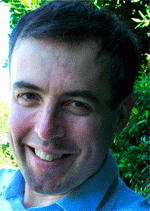
The photo above shows Meliors with a work called Sastrugi. Photo by Jody Saturday

Meliors, a simple question, but one that may have a complex answer: why are you so interested in Antarctica?

It is mysterious, dangerous, vulnerable and beautiful. The lack of flora and fauna (and pigments) focus our attention onto patterns and textures of snow and ice, sky and sea which I find very exciting to interpret visually. Its short, intense human history and its long, surprising natural history both provide thrilling stories that bear endless iterations. And ultimately at this distance, it's a blank canvas for the imagination.

If you had the chance to visit Antarctica, would you?

Um, this is tricky, because if I was offered an opportunity to go I would probably accept. But really I'm ambivalent. On one hand it would be amazing, inspiring and unlike anything else I could do. But on the other hand Antarctica is an incredibly vulnerable environment about which I am intensely concerned. I don't think Antarctica needs me as just another tourist, although I'm willing to be persuaded that I might have something of value to offer in exchange for a free ticket.

I spend a huge amount of time thinking about Antarctica and my imagination seems adequately fed through second hand sources. The compliments about my work that I treasure the most are from people who have spent time in Antarctica, who tell me I've captured the essence of the place.

And besides, its jolly cold and a bit scary down there.

You are both an artist and a poet, and for the Imagining Antarctica exhibition in Hamilton, you are giving a poetry reading / artist's talk as well as exhibiting visual art. How do the practice of art and the practice of poetry work side by side - and for that matter, how on Earth do you find the time to do both?


The Imagining Antarctica exhibition at ArtsPost

Ha! I don't really find time to do both. The past months of intensely preparing my exhibitions has been a poetry drought. Writing seems to be woven through my creative life in an irregular abstract way rather than as a disciplined practice. There are times when I write a lot, but more times when I write little or nothing. Last year was very productive though, and most of the poems I wrote then relate to the art I am showing now, hence the poetry reading and artist talk event.

Reading and looking at the entries on your excellent blog, I am struck by the hours and hours of work that goes into creating them. Can you describe your process of making them, such as the icebergs?

Most of the work I make these days starts with an old woven wool blanket which I cut into contour pieces. I needle felt each layer with a nice plump cover of unspun wool and then attach the layers together using blanket stitch. The icebergs are three dimensional, sculptural pieces so there's a lot of layers and a lot of needle felting to get the three-dimensionality.

I use a similar technique to make wall relief pieces which may use only a couple of layers of blanket and little or no felting, but can be much bigger and even more time consuming to make. My biggest work, 'My Antarctica' a scale relief map of the entire continent, took me about eight months to make. I can make a little iceberg in a week.


Meliors standing in front of My Antarctica. Photo: Marion Manson (ArtsPost)

Over time I have perversely chosen to make my stitching cruder (even though hundreds of hours of practice has made me a better stitcher). I want my work to look unmistakably handmade. With some of my earlier embroidered pieces viewers would assume it was machine stitched, and I decided I didn't want any ambiguity about that. I 'd rather have people saying 'I could make that' and so to consider what it means to stitch something by hand. I want people to contemplate the hours and hours that go into my making.

Why did you choose the craft medium, and these crafts in particular, to make your artworks (and, does the wording of that question imply a dichotomy that doesn't or shouldn't exist?)

Contemporary art is a very broad field in which there are lots of interesting craft practices to be seen. I choose craft as my means of creative expression both for the pleasure and the meaning of my making. Slow meditative hand stitching is very sensual and satisfying. By choosing hand made rather than machine made, and doing it myself rather than farming the work out to low paid women in Asia, my work implicitly critiques the economic as well as environmental impacts of industrialised consumerist culture.

You were recently in Melbourne for the opening of the "F**k Your Donation" exhibition, which includes your installation "Spoil". How was that experience, and is this part of a continuing involvement in the Australian arts scene?


Meliors' installation "Spoil" at "F**k Your Donation"

Melbourne is a fantastic city for the arts, and especially for craft practices in contemporary art. It is a real thrill to show in a gallery there for the first time, and have such an enthusiastic response to my work. I hope to go back for more soon.

One thing I know we have in common is our love for Kim Stanley Robinson's writing, and in particular his Mars trilogy. What's so great about those books?

Well, KSR's novel Antarctica turned me into a fan of Antarctica as well as speculative fiction when I first read it some 15 years ago. That book, and the Mars and Washington trilogies resonate with me as extremely plausible near-future-histories that aren't dystopias. I like his strong, complex female characters; frustratingly rare in the genre. I reread all seven novels reasonably regularly and I appreciate the detail as well as the broad sweep of his vision. But mostly because he's very good at making it seem possible that we 21st century humans could dig ourselves out of the dreadful mess our species has created, and I often feel the need for that spark of hope.

KSR's writing has had a huge influence on my visual, textile arts. For example I've turned again and again to his descriptions of the textures and colours of Antarctica as I've stitched. He's a wonderfully visual writer. In more direct homage, I once made a series of small embroidered 'Mars gardens', visualising the greening of the red planet as practised by Sax Russell and others in his trilogy.


Three of Meliors' "Mars Gardens", after Kim Stanley Robinson

Do you have any writing projects on the go that are separate from your art projects, and how do you see the balance between your art and your poetry developing in the future?

Right now I don't have any particular writing projects. Rather, I'm content to let occasional poems arise spontaneously, most often in very close relationship to the visual art I'm working on, particularly at the early, conceptual stages.

Are there particular artists and poets whose work you enjoy that you'd like to encourage readers of this interview to check out?

I'm pretty excited about sculptors Ruth Asawa (http://www.ruthasawa.com/) and Mandy Greer (http://stonemandy.wordpress.com/). I also recommend the photographs of Edward Burtynsky (http://www.edwardburtynsky.com/), and the fantastic video about his work called Manufactured Landscapes. Two of the poets I am enjoying most at the moment are Janis Freegard and Bernadette Hall.

Where people can see Meliors' work


21 October 2010

That Tingling Feeling

How To Order A Tingling Catch

I had hoped to do a full past about A Tingling Catch, the newly-published anthology of New Zealand cricket poems edited by Mark Pirie, but time has slipped away. I still hope to write that post next week, but in the meantime, I can let you know that A Tingling Catch is an excellent collection which libraries and cricket fans alike should make sure they have.

A Tingling Catch has its own blog, and Mark has now put up a post on How Do I Order A Tingling Catch? It's worth checking out.

Helen Lowe's Aus/NZ F&SF Author Series

To celebrate the Aus/NZ publication of her new novel The Heir of Night, Helen Lowe asked a number of Australian and New Zealand fantasy and science fiction authors (plus Julie Czerneda, a Canadian author with strong Aus/NZ connections) to contribute to a series of guest posts on her blog on why they love fantasy and/or SF.

The series as a whole makes fascinating reading. My own contribution, on J. G. Ballard, Kim Stanley Robinson and pitching a tent in the wide space between, was picked up and republished on the big US blog io9, which was a nice bonus for both Helen and myself.

05 November 2009

Fallen / Niedergang

A couple of years ago, a poem from my first collection, Boat People, was selected for inclusion in Wildes Licht, an anthology of New Zealand poetry with German translations, edited by Dieter Riemenschneider.

I was pleased not only because it always feels good to have work anthologised, but also because I have an interest in literary translation, and a particular liking for books which have the original on one page and the translation on the facing page.

Subsequently, however, due to a change in publishing arrangements, the manuscript had to be shortened, and mine was one of the poems cut. I was disappointed about this, but since Mark Pirie and I had undergone exactly the same process while finding a publisher for Voyagers, I recognised that this is just one of the realities of the publishing process.

Dieter was kind enough to send me the translation of "Fallen" that would have appeared in "Wildes Licht", and give me permissions to publish it here. The print version has some indentation which didn't work well online, but that apart, here are "Fallen" and its German translation, "Niedergang".

Fallen


Driving through Mandeville. Empty windows, empty houses,
a craft shop sprung like fungus from the bones of the dying town.

The cenotaph stands roadside. Blunt, unwearied,
it commends to our attention the names of the anxious dead.

They grew, these Southland towns, on the graves
of the children of Tane. Mandeville, Riversdale -
Myross Bush, Ryal Bush, Gummies‘ …

the land groaned with the weight of their money.
As the tribes were pushed to the margins, fat lambs
grew fatter. Knives flashed cold on the chains;
eels tumbled and writhed over offal.

Now, thistles nod in the hard-pan fields. Children
are a letter from the city, a ten-hour drive at Easter.
The wealth
went with them. No mirror glass monuments here.

But the Council keeps the graveyard clean; and our dust
settles impartially
on the sign: “Country Crafts - Buy Here!”
and the sign that their dead live on, and will do so, chiselled in stone,
till new trees and new ferns drag them down.

Niedergang

Eine Fahrt durch Mandeville. Hohle Fenster, leere Häuser,
ein Kunstgewerbeladen wie ein Pilz aus den Knochen der sterbenden Stadt entsprungen.

Das Ehrenmal am Straßenrand. Plump, unermüdlich
empfiehlt es uns, sich der Namen der Toten zu erinnern.

Sie wuchsen, diese Südlandstädte, auf den Gräbern
der Kinder Tanes. Mandeville, Riversdale –
Myross Bush, Ryal Bush, Gummies’ …
das Land stöhnte unter der Last ihres Geldes.
Während die Stämme an den Rand gedrängt wurden,
setzten fette Lämmer mehr Fett an. Messer blitzten kalt an den Ketten;
Aale wandten und stürzten sich auf die Innereien.

Jetzt nicken Disteln auf den pfannentrockenen Feldern. Kinder
sind ein Brief aus der Stadt, eine Zehnstundenfahrt an
Ostern. Der Wohlstand
zog mit ihnen fort. Keine Spiegelglassdenkmäler hier.

Doch der Stadtrat hält den Friedhof sauber; und unser Staub
senkt sich unbefangen
auf das Schild 'Einheimisches Kunstgewerbe –
hier zu kaufen!' und das Schild, dass die Toten weiter leben und weiter leben werden,
in Stein gemeisselt,
bis neue Bäume
und Farn sie niederziehen werden.

10 September 2009

An Interview with Frankie McMillan


Frankie McMillan is an award winning short story writer and poet. She held the CNZ Todd Bursary in 2005 and this year was the winner of the New Zealand Poetry Society International Poetry Competition. She lives in Christchurch with her partner (in a 130 yr old house) in the inner city. She is a keen cyclist and lives within biking distance of family members and her workplaces: The Hagley Writers’ Institute and Christchurch Polytechnic.


Frankie, your first poetry collection, Dressing for the Cannibals, was launched on Thursday 20 August as part of the Christchurch Central Library's 150th anniversary celebrations. How did the launch go?


It was great, thanks. A bit of chaos beforehand; the venue was changed an hour beforehand from the second floor of the library to the upper staffroom floor (where alcohol was allowed). Michael Harlow almost didn’t make it; he’d booked the wrong flight, and Robyn who was to speak on behalf of the library was too busy stuffing people into lifts, to be there for the speeches! About 50 -60 people were there, some fine speeches were made by David Gregory (Sudden Valley Press) and Michael Harlow. Live music was played, kids ran about, books were signed and the wine didn’t run out!

You've had poetry published extensively, and your poem "My Father’s Balance" won the NZ Poetry Society International Poetry Competition in 2009. But let's suppose someone is coming to your work completely fresh. What would you like to tell that person about your poetry, and about Dressing for the Cannibals?


My poems are characterised by humour, accessibility, with an often faux naïf narrator who makes observations about how it is we are ‘so mysterious to ourselves and to the world.’ The poems are fictional but have an underlying emotional truth. They reflect my interests; theatre, folklore, memory, family and the peculiarities of being human.

Themes vary, from the nature of illusion – there’s some tricksy type poems about the world of magic shows and travelling circuses to power - who holds it on a world scale or in a family context. (The poems on cannibalism were prompted by a childhood horror of being eaten.) There are a number of prose poems in the collection, a form I find really exciting to work with.

I hope the reader always knows where they are in one of my poems, but not necessarily where they are going.

Are you a poet for whom the formal aspects of poetry are particularly important?


No, the formal aspects are secondary to what I see as the exploration of an idea. I attend to certain poetic elements and the overall structure but am led more by the process whereby words/thoughts are attracted to each other. (The premise that the first idea is often the best idea possibly reflects my training in improvisational theatre.)

Dressing for the Cannibals has a very striking cover, and I see from Helen Lowe's preview of the book on Beattie's Book Blog that the cover painting is by your daughter, Rebecca Harris. Was this painted especially for your book, or was an existing work that just fitted perfectly with what you had in mind for the book?

The painting, Night Visitor, was of an existing work (2006) which was part of a series exploring the early contact between Maori and Pakeha. There is a sense of mischief in Rebecca’s work which resonates with my writing and yes, it fitted perfectly with the book’s themes. (Rebecca is represented by Milford Galleries.)

I recently interviewed Joanna Preston, and elsewhere she has commented that Christchurch is the Motown of the New Zealand poetry scene. (I think she was talking about the level of activity and productivity rather than a penchant for perfect pop singles.) I know that you’re an active participant in Christchurch poetry events; do you agree with Joanna that Christchurch is a particularly happening place for poetry at the moment - and if so, why do you think this is?

When I came back to Christchurch eight years ago, I was amazed at how many poetry groups there were but even more surprised at how many poets belonged to more than one or two. Recently a few of us ex IIML graduates living in Christchurch (fiction and poetry) have expressed an interest in getting together so possibly yet another group will form! Why do writers, poets, in particular, have a hunger for belonging to groups, I don’t know. I do know the poetry group (of which Joanna is a member) has been enormously helpful to me but possibly so too would a fiction group of which there seems relatively few in Christchurch.

I have noticed previously that poets seem to be more likely to get together, and work together, than fiction writers. Why do you think this is?

I suppose the obvious answer is that poetry, being a small form, lends itself well to discussion - there are usually no more than thirty lines to consider, unlike a 3,000 word short story or much longer novel. In a two hour meeting up to eight people can receive feedback on at least one poem each. Performance poetry can also be tried out on a small group to gauge a response. Also I think some newcomers to writing try poetry first and like the the support/feedback a group offers.

We each had our first short story collection published in 2001: in my case, Extreme Weather Events, in yours, The Bag Lady's Picnic - and, in fact, we read on the same panel at the Christchurch Book Festival in 2002. Are you writing fiction at present? If so, what fiction projects are you working on?

I’m about two thirds of the way through another short story collection. Recently my work has been chosen for Best NZ Fiction, 2008 and 2009 (Vintage) which has been encouraging. Now that my poetry book has been launched, I’ll probably alternate between the short story collection and further poetry.


How do you work? Do you have fixed times when you write, or do you grab a few minutes' writing time whenever you can?

I’m a binge writer. I think it’s more sensible to write each day but because my teaching and family responsibilities can’t always be timetabled I work flat out when I’ve got the time. I often seem to be working to a deadline which makes me incredibly focused. In that state I can work up to six hours without a break.

Which writers (of fiction and poetry) have been most influential on your own work, and which writers do you most enjoy reading?

Alice Munro, Raymond Carver, Richard Ford, Flannery OÇonnor, Annie Proulx, William Trevor and Lorrie Moore have all been enormously influential on my work. To that I’d have to add playwrights, Beckett and Pinter. New Zealand influences have been Owen Marshall and Shonagh Koea.

Poetry influences have been varied. I like this quote from Bill Manhire:

The thing you know already is the last thing you want your poem to record. Apart from anything else you want the words you use to be part of a process of discovery, part of the poem’s life not simply a recording mechanism for an entirely familiar set of observations.


And here’s one from Billy Collins:
Poetry is my cheap means of transportation. By the end of a poem the reader should be in a different place from where he started. I would like him to be slightly disorientated at the end, like I drove him outside of town at night and dropped him off in a cornfield.


NZ poets that I enjoy include Michael Harlow, James Norcliffe, James Brown, Chris Price, Bernadette Hall and Cliff Fell. Prose poem writers include Russell Edson, Robert Bly and Charles Simic.

Do you have more readings or other events lined up to mark the publication of Dressing for the Cannibals? If so, where can people see and hear you?


No, the launch activities are all sadly finished. My next public reading is under the banner of 5 NZ Poets at Our City, Worcester St Christchurch on October 2nd. Fliers are coming out with more details.

Working in the halfway house
by Frankie McMillan, from Dressing for the Cannibals

I pick up bad habits like smoking
on the back porch after lights out
and a tendency to see dead people

passing across the sky as stars
say, Freddie Baxter, who jumped

from the Takaka bridge his pockets
weighted with stones, he’s there
next to the South Celestial pole

Yours was a slow reckoning
not until spring did your bones
turn to chalk. There’s nothing

to dying you said and a small
pride lit your eyes as if you’d

mastered the trick; a clever horse
tapping its name out in letters

would you laugh to know I still
wait for your crossing, matches
in hand to frighten the dark.


Availability details for Dressing for the Cannibals

RRP:$20.00.
ISBN: 978-0-9864529-0-1

At present books can be purchased
- in Christchurch from Madras Café Books, Scorpio and University Bookshop.
- in Wellington from Unity Books and University Bookshop
- in Auckland from Parsons and the University Bookshop (UBS)

You can also direct order Sudden Valley Press: email canterburypoets (at) gmail.com

07 September 2009

Book Review: Letters from the Asylum, by John Knight

Letters from the Asylum, by John Knight, published by Sudden Valley Press, distributed by Madras Cafe Books. RRP NZ$25 (incl postage).

John Knight is an Australian poet. You can find an interesting interview with him, and a bio, here. There is a lengthy and very well-put-together review of Letters from the Asylum by Patricia Prime at the Stylus Poetry Journal. I won't attempt to be as comprehensive in this review, but I'll begin by saying that I enjoyed reading this collection by a poet whose work I'd never read before.

Letters from the Asylum
begins with a lengthy introduction by John Knight, in which he mentions his terminal cancer, and also endeavours to situate himself, poetically and personally, within the context of postmodernism and psychoanalysis. Not being a huge fan of either, this introduction made me nervous about what was to follow; but John Knight's poetry wears its theoretical underpinnings very lightly - in fact, the titles of poems often bear more evidence of "theory" than the poems themselves.

Much of the subject matter of this book isn't easy. It encompasses the deaths of several people close to John Knight; his own illness and impending death; and also, facing the wider world, the deaths of many, near and far, known and unknown, in war. Some of the poems which are about the generalised horrors of war are excellent, such as "Pantocrator [Insert Year]" (p. 70), but in the main, the poems I responded to most are those in which these issues are made concrete in the lives of individual people, such as "...and burned the topless towers of Illium" (p. 24), about a Greek woman, "no friend of the Colonels", now living in Australia, with its lovely closing couplet:

I left, too embarrassed to return or explain.
I've forgotten my Greek, and her name.


Another fine poem that deals with the death of one person, in this case by suicide, is "somewhere south of eden" (p. 36). It has a shorter line than most of the poems in this book, and for me, this works very well with the subject matter:

spike your hair
make up your face
it's the last act

place the list
in your pocket
do not leave a note


Though the overall tone of the collection is sombre, the book is not without hope, if not for this life then for another. It ends with "Resurrection..." (p. 93), and that poem ends on an upward note:

Leaving the stones and the small wet world
whose sky meets air with water, turn
to the sun through the skin of the sky
and wait for the changing. Dragon no longer
but a prism of light shot across
the still pond. Quick, I'm gone!


John Knight is a fine poet, and this is a fine collection.

24 August 2009

Astropoetica: Mapping The Stars Through Poetry

In 2003, I came across a call for submissions for a new webzine, Astropoetica. Its mission statement was "Mapping The Stars Through Poetry", and editor Emily Gaskin had the excellent idea of launching it with a Constellations Issue: at least one poem for each of the 88 constellations recognised by the International Astronomical Union.

"That sounds like a good idea," I thought, and set about finding some Southern Hemisphere constellations that would by the overly-prosaic Abbe Nicolas-Louis de Lacaille - you can see the poems at the bottom of this post. Octans is the constellation which contains the South Celestial Pole.

Later, I had poems in a couple more issues, including two in the Solar System Issue - these two form part of the Mars sequence in All Blacks' Kitchen Gardens. But, not having written any suitable poems for a while, I was especially pleased that my poem Losing Weight was included in the latest issue.

I'm not the only New Zealand poet to be included in Astropoetica: Mary Cresswell has been published there several times, and Su Lynn Cheah had two poems, including a particular favourite of mine, Insects, in the Constellation Issue.

It isn't easy to keep a small-press magazine appearing so consistently, especially when you're paying the contributors. Emily Gaskin has done both poetry and astronomy a great service with Astropoetica, and if you are interested in either, I recommend it.

Three Constellation Poems


Antlia, the Air Pump

The good Abbé
had a telescope, and time
and a cloth ear
when it came to names

Abbé Nicolas-Louis de Lacaille
You'd think a name like that
would awaken a sense of rhythm
in the most prosaic of men

a sense that would guide his choices
as he looked up
from the Cape of Good Hope
at a southern sky crying out for names

But no. He wished to honour
Robert Boyle, great father of the Air Pump
Antlia Pneumatica and Machine Pneumatique
that's the name he lumped me with

Dogs, bulls, and virgins
wrapped in their antiquity
chased me from the north
with their mortifying laughter

Later someone had mercy
shortened me to Antlia
People now think
I'm named after ants or antlers

Squint and you can see me
crawling through the southern sky
keeping my head down
as air leaks from my broken heart

Horologium, the Clock

Clock, clock
Tick tock
In the southern sky
Counting down the lonely years
All are born to die

Clock, clock
Tick tock
Entropy remains
As your stars drift out of reach
Leaving only names

Octans
, the Octant

I was there when the Yamana
sailed south from Cape Horn
in their flimsy bark canoes
and found a world of ice

I was there when the Maori
dared the Southern Ocean
in twin totara logs
sailing from Te Waipounamu

There for Ross and de Gerlache
Bellingshausen and Borchgrevink

Nothing much to look at
Not shining like Polaris
But when they came to the South Pole
I was there

When Roald Amundsen
planted the flag of Norway
at his best guess at the Pole --
I was there

When Robert Falcon Scott
lay down for death to claim him
Somewhere high above the blizzard
I was there

There for Mawson and Shackleton
for Hillary and Byrd

Nothing much to look at
Not shining like Polaris
But when they came to the South Pole
I was there

Above the chattering of tourists
and the scientists' endeavours
Above the melting and the greening
I'll be there

When the sea level rises
and the ice turns into water
Or when a new ice age beckons
I'll be there

There for artist and astronomer
Protester and prospector

Nothing much to look at
Not shining like Polaris
But when they come to the South Pole
I'll be there

Antlia was included in All Blacks' Kitchen Gardens. Horologium and Octans have not been collected in book form.

04 June 2009

Poetry Runway: Promoting Poetry, One Contestant At A Time

UPDATE: As Jack Ross has pointed out (see the comments), Project Poetry is a much better title than Poetry Runway.

I went to Palmerston North yesterday to read in the Stand Up Poetry series at the very impressive Palmerston North City Library. I really enjoyed myself: I had a great time reading to an appreciative audience, sold plenty of books, had a lovely dinner before the event and lengthy pub discussions about poetry afterwards, and enjoyed meeting lots of new people and some poets I'd only met virtually before, including series MC Helen Lehndorf and my overnight host, Tim Upperton.

And it was on the way home from Palmerston North that the idea came to me. If reality TV shows could work for modelling (America's Next Top Model), fashion (Project Runway), and the chance to enjoy the sexual attentions of Brett Michaels (Rock of Love), then why not a similar show for poetry? Because Project Runway is the only one of those shows I actually like, and because I have no imagination, I think it should be called Poetry Runway.

Here's the set-up: fifteen arriving poets are selected to enter the competition, under the wise mentorship of a debonair poetry expert (Billy Collins, perhaps, or Margaret Atwood, or, if available, T. S. Eliot). Each week, they must complete a poetry challenge - a pantoum, a villanelle, a book-length encomium to Elizabeth the First - and each week, they must present themselves to the judges (obviously, the panel must be chaired by a supermodel, but the other members could be distinguished poets). Each week, one poet will be eliminated.

For three months, weekly at 8.30pm, we inhabit these poets' lives. We see them triumphant, we see them despairing, we see the tears of each eliminated poet as they are given ten minutes to return to the workroom and pack away their laptop and thesaurus. We get up close and personal with the bitchy and the noble; we see the proud humbled and the meek exalted.

For the lucky winner, the rewards are many: a year-long poetry residency at a distinguished Midwestern university, guaranteed publication of their next collection, possession of the final Humvee to roll off the assembly line, and a seven-page spread in Elle magazine. But first, the top three contestants must face the ultimate challenge: putting on a half-hour poetry show at New York Poetry Week while the city's leading poets chatter obliviously and clink their glasses.

Poetry fever would grip the world. Slim volumes would sell like slim hot cakes. Watercooler conversations would revolve around Heid Klum's harsh comments on the use of ampersands. The show would be franchised, and here in New Zealand we'd all get to compete for a brand new bus pass and a chance to fall over in front of Jason Gunn.

I have the vision. All I need now is a television producer with a lot of money and very little common sense. Are you out there?

Portions of this blog post not affecting the outcome have been removed in consultation with the producers.

17 May 2009

Voyagers: Here At Last

I was going to do a much longer and more complicated blog post tonight, but I'm too tired. So instead, this is just to say that I have a copy of Voyagers: Science Fiction Poetry from New Zealand sitting right here besides me, and that feels good!

Mark Pirie and I started on this project in 2004, when we called for submissions for our planned anthology of New Zealand science fiction poetry. While submissions were coming in, we went off and deepened our knowledge of New Zealand poetry by looking for previously-published SF poems. (Well, I deepened my knowledge - Mark's was pretty deep already.)

By mid-2005, we had the first version of the manuscript pretty much sorted out. As I've previously recounted, finding a publisher proved to be difficult, and we were very pleased when Interactive Publications of Brisbane took the project on in 2008. We couldn't include all the poems we wished, but those we have included look rather good to me. You can find sample poems from the book, by David Gregory, Meg Campbell and Mary Cresswell, at the Voyagers mini-site (bottom right of that page).

Mark and I will be sending out contributors' and review copies over the next couple of weeks. There will be a New Zealand launch for Voyagers in July, but if you'd like to get a copy while it's fresh off the presses, you can buy it from Amazon.com as a paperback or Kindle e-book (search for "Voyagers: Science Fiction Poetry"), or from Fishpond in New Zealand. You can also find out more about Voyagers, and buy it directly from the publisher, at the Voyagers mini-site.

10 May 2009

An Interview with Iain Britton


Iain Britton had his first collection of poems, Hauled Head First into a Leviathan, which was a Forward Poetry Prize nomination, published by Cinnamon Press (UK) in February 2008. Interactive Press (Australia) is about to publish his second collection, Liquefaction.

Iain, let's start with Liquefaction, your new collection. What would you like readers of this blog to know about it?


Liquefaction is a collection of 35 poems following no specific theme, although I would like to think my work does have connecting lines of thought that can be identified when one reads through it. Each poem should be approached as a portal for the eyes to ‘walk’ into, for the reader to pass through and hopefully experience something different and then elicit pictures, images, word associations that they will find interesting.

The collection will be released on 15 May and is available through www.amazon.com or it can be ordered directly through Interactive Publications - www.ipoz.biz/Store/poetry.htm.

At the moment, my understanding is that the collection will be launched in New Zealand in July 2009, when Interactive Press will also be promoting two other NZ publications – Voyagers: Science Fiction Poetry from New Zealand, editors Mark Pirie and Tim Jones, plus The World Cup Baby by Euan McCabe. I presume the three books will then be available in bookshops in New Zealand.

You have been extensively published overseas, and your previous collection, Hauled Head First into a Leviathan, was published by Cinnamon Press in the UK and nominated for the Forward Poetry Prize for Best First Collection. Have you published primarily overseas by choice, or is that just how things worked out?


As a poet, I enjoy the challenge of publishing offshore and watching how my poems are accepted or rejected and also observing how NZ poetry is generally received overseas. We have many fine poets pushing their poems around the world and it’s great to see we are prepared to promote this aspect of our culture internationally. It’s a huge and essential learning curve to try and stand beside the best poets in the UK and US and elsewhere. I see everything ‘right’ in that.

How long have you been writing poetry, and what motivated you to start?

I have been writing poetry seriously since my first NZ publication in 2000. Prior to that I had a long haul through years of writing – completing 5 very unpublishable novels, all now consigned to some bin. I also had a number of years spent writing plays in the UK. I really enjoyed writing plays and even had the audacity to try to get major repertory theatres to accept them … of course, they didn’t! However, poetry has always been a real life force within me, so it was only a matter of time till mind, body and soul coalesced and began pushing the pen with a degree of success.

Can you identify poets, or poetic movements, that have influenced your own poetry, and if so, who or what are these?

Learning to be a good poet requires total commitment and an inner sense of belief in oneself, that this is what you want to do, combined with a feeling of allowing yourself to be driven by it. I have had the privilege of seeing/hearing such great poets as Thom Gunn, WH Auden, Robert Lowell, Octavio Paz, Yevgeny Yevtushenko, Robert Graves and many others during years spent in London. It is also where I first heard Fleur Adcock read her poetry. Once I had decided that poetry was what I wanted to do, I was hooked.

My reading has been wide and varied and I have involved myself in most movements of one sort or another. The Americans of the middle and latter part of the 20th Century impressed me with their willingness to experiment and push literary boundaries. Many poets have influenced my writing over the years and each one has contributed to my ability as a poet eg T S Eliot, Dylan Thomas, Robert Lowell, Sylvia Plath, Rae Armantrout, Robert Creeley, Seamus Heaney, John Ashbery, August Kleinzahler, Charles Bernstein, Jorie Graham, the NZ poets Allen Curnow, James Baxter, Hone Tuwhare, Bill Manhire and so on. Even the great Romantics have a place in my learning. Perhaps, my small knowledge of Te Reo and Tikanga Maori and all they entail has been vital to the sounds and rhythms of my writing also.

Consequently, you can see the field of influence is huge and those groups of individuals associated with poetic movements are part and parcel of this learning process too.

Your poem "Departing Takaparawha" is included in the forthcoming anthology Voyagers: Science Fiction Poetry from New Zealand. Do you write much poetry that falls within the "speculative poetry" genres (science fiction, fantasy, horror), or were your submissions to that anthology fairly much a one-off?

This is an interesting question for me to answer as my poetry probably does at times verge on the fantastic. For many poets the metaphor is an integral literary device and this can lead to highly imaginative pieces of work. My poetry could be said to tend towards the surreal sometimes. It is open to many interpretations but I don’t write with any exclusive kind of poetical form in mind.

Do you regard yourself as an "Auckland poet", or is it simply the case that you are a poet who lives in Auckland? Is there such a thing as a distinctively Auckland poet, and if so, what makes an Auckland poet distinctive?

My sister-in-law, who is based in the UK, once asked me a similar type of question after a poetry reading I had given at the London School of Economics a few years ago – whether I considered myself a poet (for everyone) or a NZ poet. My answer was ‘a poet first and foremost’. This applies also to the idea of being an Auckland poet or not. I don’t think of boundaries when it comes to poetry. Although I am aware of these city differences, I don’t particularly espouse to any of them. Good poetry should cross borders and touch hearts regardless.

Do you enjoy performing your poetry, and are you planning launches, readings and so forth to mark the publication of Liquefaction?

Yes, I enjoy the challenge of reading my work, rather than performing it. Reading is never easy. The inner voices are an interesting mob to deal with when you stand and deliver. They determine the sound, rhythm and nuances and I feel I must do justice to the poem that has been channeled through me. It is a big responsibility to get it right. But that is what being a poet is all about for me.

I hope to promote my poetry collection with readings at the launches, which are to be in July. The timing will be important to enable this to happen. As yet, I have no dates, but I know Interactive Publications are well into the planning stages.

On a final note relating to Liquefaction, I wish to express my gratitude and thanks to Gretchen Albrecht, for providing the incredible cover image from Chorus 2008.

13 April 2009

A Suitable Anthology for Easter

Helen Lowe alerted me to the following competition and anthology, which seems like a suitable one to post about at Easter:

Spiritual Writing Competition

Closes: End of May

Judged by a church-based panel led by Pleasant Point writer Karalyn Joyce

Prizes: 1st $500; 2nd $250; 3rd $100

Up to 50 submissions are to be published in a new "Spiritual Anthology" launched in November 2009

Calling for all non-published poems/fiction/non-fiction work with a "words to inspire" based theme; i.e., life; death; creation; peace; miracles; wonder; reflection from new and established writers of all ages

For entry form send a stamped self-addressed envelope to: "Spiritual Anthology", 4a Horton Street, Pleasant Point, South Canterbury; or email: daphnej (at) xtra.co.nz

The entry form has further details:

  1. Submissions (fiction/non-fiction or poetry) must be the original work of the entrant, previously unpublished and not under consideration elsewhere. A suggested length for stories is up to 1,500 words. Poetry is suggested to be no more than 50 lines. The editing team reserves the right to select work from the submissions received and will contact the writer to gain publishing rights but copyright will remain with the writer.
  2. Contributors published in the anthology to receive a free copy in lieu of payment, and the right to order further copies at a special rate. Prizes to be presented at special launch of the anthology in November, or forwarded to the writer following the launch.
  3. The theme is: “words to inspire” (i.e., life; death; love; peace; grace; miracles; healing; creation; reflection; spirituality).
  4. Winners and the writers of the chosen work for the anthology will be notified by email/telephone, others will be destroyed unless there is a stamped self-addressed envelope with the submission.
  5. The entry fee is $2 per poem/ $5 per short story and writers are welcome to enter two or more times. The competition is open to all ages.
  6. Entries are to be typed single sided A4 paper and double spaced.
  7. Judge’s decision is final.
  8. The writer’s name must not appear on the manuscript. Please use the entry form below. Photocopies are acceptable.
  9. The closing date is the 31st May 2009.

19 March 2009

Reading Poetry at Madras Cafe Books in Christchurch (feat. North)

Last night, I was a guest reader, together with Fiona Farrell and Victoria Broome, at the first weekly session of the Canterbury Poets' Collective Autumn Readings Series at Madras Cafe Books in Christchurch.

I had a terrible cold, but a good time. I was going to post a full and judicious report, but I discovered tonight that Catherine of Still Standing on her Head had got there before me, so I am going to recommend that you read her excellent report. I'll just throw in a few additional comments:

  • I liked the venue. Madras Cafe Books does what it says on the label: There's a cafe, with seating inside and out, and behind the cafe, a bookstore. The food at the cafe was delicious (I was very bad and had a mocha slice), and although the bookshop isn't large, it has a good selection of interesting books from both New Zealand and overseas. Definitely recommended.

  • I was impressed by what I saw of the Canterbury poetry community (I'm not sure how many people came from out of town). There was a very good turnout, people were certainly friendly to me and seemed friendly to each other, and the standard of the poems read at the open mike part of the evening was high; there were many contenders for the prize for best poem from this section, won by Joanna Preston. It was great to meet poets I only knew by name or reputation, such as John O'Connor and James Norcliffe, as well as those I had met before - and I was especially pleased to be able to thank Fiona Farrell for including my story "Win a Day with Mikhail Gorbachev" in Best New Zealand Fiction 4.

  • It isn't easy to read poetry to an audience when you have a sore throat. I was surprised my voice held out; I guess adrenalin got me through. Hardest of all the poems to read was "North", from my first collection, Boat People. I do the Yorkshire-y bits in a variety of Yorkshire accents, and it isn't easy trying to sound like the Clitheroe Kid when your voice is threatening to give way. Maybe I'll put up an audio file one day, but in the meantime, here is North, inspired by my visit back to the land and accents of my birth in 1989 - with apologies to Harvey Molloy, who has had to put up with my lame renditions of accents not entirely dissimilar to his when he's heard me read this poem.

North

On Ilkley Moor
I parked me red
Ford Laser hatchback
and gazed to the north.
Rain and smoke stood over Wharfedale.

It was all in its appointed place:
stone houses and stone smiles in Ilkley
the wind on the bleak
insalubrious bracken.

I was waiting for memory
to make the scene complete:
some flat-vowelled voice out of childhood
snatches of Northern song.

For memory read TV:
Tha’ve broken tha poor Mother’s heart
It were only a bit of fun.
Bowl slower and hit bloody stumps.

Tha’ll never amount to much, lad. In cloth cap and gaiters,
car forgotten, I pedal down the hill. Hurry oop
or tha’ll be late for mill. Folk say
I’ve been seeing the young widow Cleghorn.
Well, now, fancy that.

In my invented character
I trail my falsified heritage
down the long, consoling streets.

15 March 2009

Enamel: The First Issue of a New Literary Journal

Emma Barnes, in addition to being a fine poet herself, is the editor of the new literary journal Enamel. The first issue of Enamel has just been published, and I'm pleased to say that I have two poems in it: "The Penciller" and "Nightlife".

Emma starts her editorial by saying:

When I decided to start Enamel I naively placed the word pro-feminist in my call for submissions. At the time of writing I phrased it as a slight bias toward pro-feminist literature. Little did I know that this would cause a dearth of submisions from anyone who didn't identify as a woman. Tumbleweeds rolled across my inbox.


Well, Emma seems to have dealt with that tumbleweed problem (you can probably turn rolling tumbleweeds off using a hidden option in Gmail), because there are some fine poems in this first issue of Enamel - although it's true that not many of the poets are of the masculine persuasion. The poets represented in this issue are Johanna Aitchison, Anna Forsyth, Tim Jones, Miriam Barr, Jennifer Compton, Helen Heath, Reihana MacDonald Robinson, Andrew Coyle, Meg Davies, Elizabeth Welsh, Ruby Mulholland, Meliors Simms, Lori Leigh, Marcia Arrieta, and Helen Rickerby.

On my first, quick look at the issue, poems that stood out for me included "Extravagant Promises" by Meliors Simms, "Useful Cupboards" by Jennifer Compton, and "Nothinghead" by Helen Rickerby. But that's just on a first look: I am sure there will be more when I take the time to look again.

Emma is selling hard copies of Enamel through TradeMe for a price between $10 and $15. PDF copies are available for a donation. And if you're interesting in contributing, the next issue of Enamel is due to be published in March 2010.

24 February 2009

Canterbury Poets Present: Autumn Readings 2009

Poetry in Performance: Autumn Readings 2009

  • Open microphone and guest readers 
  • Wednesdays 6.30pm $5 entry 
  • Madras Café Bookshop, 165 Madras St – licensed and BYO. 
  • Win a $20 MCB voucher – audience vote for the best open mike poet each night 

And here's the lineup:

18 March: Tim Jones (that's me, folks!), Fiona Farrell, Victoria Broome

25 March: David Howard, Marissa Johnpillai, Helen Lowe

1 April: Frankie McMillan, Tusiata Avia, Ben Brown

8 April: Ian Wedde, Charlotte Trevella, Helen Yong

15 April: Richard Reeve, Diana Deans, John O'Connor

22 April: Bernadette Hall, The Hagley Writers

29 April: Kevin Ireland, Joanna Preston, Koenraad Kuiper

Everyone welcome; enquiries to: joyces (at) clear.net.nz

Yes, I'm off to Christchurch! I'm really looking forward to the opportunity to read in my Dad's home town, and to take part in a reading with Fiona Farrell, to whom I am indebted for choosing my story "Win a Day with Mikhail Gorbachev!" for The Best New Zealand Fiction: Volume 4. If you're in Christchurch, please come along to one or more sessions. This looks like a great line-up.

18 February 2009

Calls for Submissions

Two calls from submissions that may be of interest to New Zealand writers:

1) An Anthology of Writing about Canterbury

Wily Publications invites submissions of poetry and short prose (up to 2000 words) for an anthology featuring writings about Canterbury – coast, plains and high country. Fiction and non-fiction, current and historical works are welcomed, but copyright must be held by the person submitting the work. Work may be previously published, but not anthologised.

Submissions must be typed, double spaced (poetry may be single spaced), on one side of A4. Please ensure that name, postal and email addresses are included, a statement of ownership of copyright, as well as a stamped self-addressed envelope. Submissions will not be returned, and unaccepted work will be destroyed. Following publication, a small payment will be made for accepted work.

Please send submissions to: Canterbury Anthology, 37A Holly Road, Christchurch 8014

Submissions must be received by 28 February 2009.

2) US poetry journal looking for New Zealand poetry

Reconfigurations: A Journal for Poetics & Poetry / Literature & Culture

Reconfigurations is seeking excellent contemporary New Zealand poems for its November 2009 issue. Edited largely in the U.S., Reconfigurations is an electronic, peer-reviewed, international, annual journal for poetics and poetry, creative and scholarly writing, innovative and traditional concerns with literary arts and cultural studies.

Bryan Walpert will make the initial selection of poems. These will then be peer-reviewed by a panel of editors at Reconfigurations, who may opt to take all or only a selection of these. Please send up to five of your best poems by 15 April 2009 in a single Word file attachment to Bryan Walpert at b.walpert (at) massey.ac.nz along with a bio in the body of the email of up to 75 words. Please simply use “Reconfigurations” as your subject line. Unpublished work is preferred and will be given priority, but work published only in New Zealand will be considered. If you include published work, please indicate which poems have been published, where, and when.

04 February 2009

Voyagers: A New Zealand Science Fiction Poetry Anthology

In 2004, Mark Pirie and myself decided that it would be a good idea to put together an anthology of New Zealand science fiction poetry. We knew that there were people writing science fiction poetry in New Zealand, and we knew of a few published examples of NZ science fiction poetry. How hard could such a project be? So we put out a call for submissions, and many poets responded with new or previously-published work.

At the same time, we split the corpus of New Zealand poetry (hmmm, "corpus", never thought I'd use that word in a blog post) between us and looked everywhere we could for published NZ SF poems. We were amazed how many we found: nuclear apocalypses from the 1950s and 1960s, utopias and dystopias from the 1960s and 1970s. We used a reasonably broad definition of science fiction, but even so, we found more poems than we could use. We discovered that poets such as Allen Curnow, James K. Baxter and Cilla McQueen had written science fiction poetry.

The next problem, finding a publisher for the anthology, proved to be a little harder. Most New Zealand publishers we approached did not think the anthology was a commercial proposition; one publisher took on the project subject to its receiving Creative New Zealand funding, but the publishing application was unfortunately unsuccessful.

It seemed that we had run out of options to have an anthology of the desired size and quality published, but then Mark approached Australian publisher Interactive Publications, having heard that they were to publish a book of Iain Britton's poetry. We were very pleased to hear that Interactive Publications were willing to publish the anthology in a print run large enough to make it worthwhile.

The next step was to go through the lengthy process of getting permissions from authors and publishers to reprint poems which had previously appeared elsewhere. Interactive Publications was unable to offer payment to authors, something we had wanted to do, and understandably, some authors and publishers pulled work from the anthology because of this. However, this gave us the opportunity to refresh the anthology with some newer poems, and at last the manuscript has been completed and sent to the publishers - except for the Contributors' Notes, which I'm currently collating.

I'm really pleased that we have finally got this project off the ground after many years of trying. I think it's going to be a fine anthology. I'll tell you more as the publication date approaches.

25 January 2009

"Swings and Roundabouts: Poems On Parenthood" Revisited


Shortly after the publication of Swings and Roundabouts: Poems on Parenthood (which you can buy online from Fishpond or New Zealand Books Abroad), I gave my initial thoughts on the book, but said that I wouldn't review it because I have a poem in it.

Well, I changed my mind. I've completed reading Swings and Roundabouts over the past two weeks, and though I'll leave my own poem Coverage to speak for itself, I want to reiterate what a good book this is.

It's true that Swings and Roundabouts is likely to speak most strongly to parents, but these poems are strong as poems, not just as aspects of parenthood. After an excellent introduction by editor (and parent) Emma Neale, the book is organised in chronological order, starting with pregnancy and ending with the deaths of children and parents - though the tone of this final section is not morbid. The poems are interspersed with quirky and enjoyable photos by Mark Smith.

This is predominantly an Australasian anthology, but it also includes poems by Sylvia Plath, Sharon Olds and Louise Glück. In her introduction, Emma Neale suggests that Lauris Edmond could be regarded as the local poet laureate of childhood, and she has five poems here. Many well-known New Zealand poets are represented.

There are hardly any poems I don't like, but poems that especially stand out include "Helpless" and "Yellow Plastic Ducks" by Graham Lindsay, "The Vending Machine" by Anna Jackson, "35/10" by Sharon Olds, "Your Secret Life" and "Your Secret Life 2" by Harry Ricketts, "It Allows a Portrait in Line Scan at Fifteen" by Les Murray (and yes, the title does make perfect sense, and is very moving, in the context of the poem), "Festive Lentils" by James Norcliffe, "Stay in Touch" by Laurice Gilbert, and "The Names" by Lauris Edmond.

But if I had to choose just one poem from this book, it would be "Child" by Sylvia Plath: small, vivid, memorable.

Like a child, like this book.

12 November 2008

What I'm Writing

I set up this blog to write about and promote the three books I had published between September 2007 and June 2008 - All Blacks' Kitchen Gardens, Anarya's Secret and Transported - plus post about other writers, books, and matters of interest to me. I've been doing all that, and will keep doing it, but I realised a few days back that there was one topic I hadn't tackled: what I'm writing now.

I write short stories, poetry, and novels. Inefficient, maybe, especially for someone who writes part-time, but that mix doesn't seem likely to change in the near future - because I've got all three types of writing on the go. My main focus is my new novel, but short stories and poetry refuse to be entirely set aside.

First, the novel. I'm prone to calling it "my new novel", but that's not strictly accurate. Before I wrote Anarya's Secret, I had written another novel, with the working title "Antarctic Convergence". The jumping off point for "Antarctic Convergence" was a story I wrote in 2000, "The Wadestown Shore", which is included in Transported.

[SPOILER ALERT]

This is the story that begins:

I cut the engine in the shadow of the motorway pillars and let the dinghy drift in to the Wadestown shore. The quiet of late afternoon was broken only by the squawking of parakeets. After locking the boat away in the old garage I now used as a boatshed, I stood for a moment to soak in the view. The setting sun was winking off the windows of drowned office blocks. To the left lay Miramar Island, and beyond it the open sea.


and ends:

The sunken office blocks of the Drowned city were far behind me. The rich waters and virgin shores of Antarctica lay ahead. I made my way forward to greet them.


[/SPOILER ALERT]

"The Wadestown Shore" is (in revised form) also Chapter 1 of the novel.

I finished the initial version of this novel in 2004, but was unable to get it published. I decided to shelve it for a while, write something else (that turned out to be Anarya's Secret), and then revisit the novel and the feedback I'd had on it.

I did that earlier this year, and though there are some valid arguments against rewriting your first completed novel, I felt that the basic idea of "Antarctic Convergence" was still good, but that the novel had major structural problems, especially in its second half. So I'm rewriting it pretty much from scratch, and I'm almost half way through the redraft. More news, I hope, in 2009.

Next, the short stories. I've written three new stories since Transported was put to bed, and am currently working on a fourth which I'm trying to finish in time for an anthology submission deadline. That isn't exactly enough for a collection, and I'm putting completing the novel ahead of writing lots more stories, but I will keep plugging away. When new stories of mine do appear in print or online, I'll let you know.

Last but not least, the poetry. Although All Blacks' Kitchen Gardens was published in 2007, I completed the manuscript (more or less) in 2005, so I have had three years to get some more poetry written. But, whereas I can decide that I'm going to work on my novel for the next two hours, sit down, and get 1000 or so words written, I have found that I can't make myself write poetry: it arrives when it wants, and when it doesn't want, nothing will induce it - yes, it's that old favourite "the muse" again!

All the same, when checking the other day, I found that I had 29 poems which I'd consider putting towards a new collection - and what's more, 29 poems that fit a theme. Will I write more poems that fit this theme and assemble them beautifully into a collection, or will I go off on a complete tangent? Watch this space!

05 November 2008

Before the Sirocco

The New Zealand Poetry Society is launching its annual anthology, this year entitled Before the Sirocco and edited by Joanna Preston, in Wellington at 6pm this coming Saturday, New Zealand election day. Here are the details:

Date: Saturday 6 December

Time: 6pm

Venue: Turnbull House, 11 Bowen Street (near the Bowen St/Lambton Quay corner)

What it's all about: Take your mind off elections for a couple of hours! Come along to the launch of the New Zealand Poetry Society's 2008 anthology, Before the Sirocco, and hear poets young and old read their work from the anthology — including winners and runners-up in the Poetry Society's annual International Poetry Competition.

The buzz: The NZPS anthology launch is one of the few occasions on which poets from around the country get together. If you want to take the temperature of the New Zealand poetry scene, this is the place to be - and you'll get to hear some great poetry as well.

Plus, you can buy a copy of Before the Sirocco there. Isn't the cover great?

05 October 2008

An Interview with Harvey Molloy


Harvey Molloy is a Wellington teacher and poet whose first collection of poetry, Moonshot, has just been published - which made this a very good time to interview him by email.


First of all, congratulations on the publication of Moonshot. What can you tell me about the book, and where can interested readers find more information, and copies to buy?

Moonshot is my first book of poems. It's divided into two sections. The first 'Gemini spacewalk' explores space, the universe, and how space features in the imagination. The second section 'Learning the t' is down to earth and concerned with travel, particularly my time in Singapore, and family relationships. The book is orchestrated to follow these themes but some poems don't fit this pattern and I've included them because I like the poems. You can find out more about the book over at my blog at http://harveymolloy.blogspot.com and you can order the book from me from the blog.


Moonshot is your first poetry collection: a significant milestone for any poet. How long have you been working towards having this first collection published?

I started to write poetry again back in the mid 90s. In 2000 I moved to Singapore to work at the National University of Singapore. At this time I became interested in Asperger Syndrome, which is an autism spectrum disorder, and wrote some research articles in this area. After Latika and I finished our book Asperger Syndrome and Adolescence: Looking Beyond the Label, which was published in 2004, and moved back to New Zealand, I began to focus more seriously on the poetry. About four years ago I decided that I had enough poems published in different journals to put together a manuscript. So I guess I've been working on it seriously for four years or so although it’s been on my mind for around eight years.

They say “It’s tough oop North”, and if it is, the two of us should know, since you were born in Oldham and I in Grimsby. Though you’ve lived in many countries since then – the States, Singapore, New Zealand – do you think there’s a Northern English sensibility to your poetry?

Yes, I do. The northern sensibility comes through in the sound of the words. Living right on the Pennines also has a powerful effect: the northern landscape is incredibly varied: it's both ruggedly rural and horribly industrial all within the same borough. I think that there's a particularly Manchester sensibility: it's part humour, part gothic horror, and part self-parody. Lancastrian is the only accent that sounds as if it's mocking itself or refusing to take itself seriously whilst also sounding out the very roots of the language. And I also think there's a 'Lancastrian male hysteric' element in the culture; northern masculinity is very different and more feminine than the 'kiwi bloke' culture: you see this in Billy Liar, in Alan Garner's novels, in Amis's Lucky Jim, and in bands like The Fall, Joy Division, Magazine and The Smiths, etc.

We have something else in common: an interest in science, and in science fiction. I was intrigued and impressed to see that you’ve put the science and science fiction poetry up front in “Moonshot”, whereas in my books, it’s been tucked discreetly down the back. What made you decide to put this section first?

Part of this has to do with Helen Rickerby's advice. I sent an early version of the manuscript to her and she suggested that I organise my material more thematically and write more about space. Although all the threads were there until I had her help I couldn’t see the shape I wanted. I'm not that fixated on SF or space – the new work is different – but I am committed to what I very loosely think of as a SF or fantasy sensibility that I clicked on around age 12. I remember seeing J.G. Ballard on a BBC book programme when I was 13, talking about his novel Crash. It just reprogrammed me in much the same way that Alan Garner's Redshift changed my life. Garner's and Ballard's work aren't SF or fantasy but they are deeply concerned with 'psycho-landscapes' or unusual geographies. I wanted the astronomical poems up the front as many poets write about their families and their childhoods but few write about astronomy.

When I jotted down the recurring themes of this collection, the words “astronomy”, “history”, “geography” and “myth” appeared. Have I made them all up? Have I missed any? Why do these areas especially interest you?

No, I think that's accurate but "history", "geography" and "myth" are also connected with family life. I'm married to an Indian New Zealander and part of me lives in an Indian world and this hopefully comes through in some of the poems. In some ways, I think each individual is a culture with their own myths and I'm trying to explore some of these myths. But I'm also trying to include a variety of different voices and concerns in the poems.

Which poets have had the most influence on your work, and which poets do you most enjoy reading? (Of course, these might be one and the same.)

The following are a selection of poets I love to read and who have moved me: Hone Tuwhare, James K. Baxter, Elizabeth Smither, Sylvia Plath, Seamus Heaney, T.S. Eliot, Adrienne Rich (marvellous), Philip Larkin, etc. and I'm particularly fond of Alistair Paterson's Qu'appelle (talk about a SF sensibility: Wellington gets nuked!). Recent books I’ve enjoyed are Sue Wootton’s Magnetic South and Helen Rickerby’s My Iron Spine.

How about prose writers?

Alan Garner's an amazing writer and I think Neil Gaiman's brilliant: it's a pity that Gaiman’s film work doesn’t match his prose. And Samuel R Delany’s Dhalgren has a lot to answer for! I also enjoy reading good science writing and have wide ranging reading habits: I’m currently on the last chapters of George Eliot’s Middlemarch and next up will be Mary McCallum’s The Blue.

A tough one to end on: if you had to choose three words to describe your writing, what would they be?

On the line

24 September 2008

Boat People, my first poetry collection


Boat People is my first poetry collection. It was published in 2002 by HeadworX, the year after my first short fiction collection, Extreme Weather Events. There are forty poems in Boat People. The book is divided into four sections. As the HeadworX publicity blurb says:

"Boat People" is in four sections. The first is inspired by the poet's childhood in Southland and adolescence in Otago. The second focuses on the Wellington region, and includes poems about the poet's experiences of fatherhood. Section III takes in Russia - Tim Jones speaks Russian and has a longstanding interest in the country - while Section IV journeys to the alternate world of time and space also depicted in "Extreme Weather Events".


A number of poems from Boat People dealing with parenting have already been posted on this blog. Here's one more poem from Boat People, a personal favourite.

1917


A hard day's plotting gives a man a thirst.
For Lenin, it's something dark and strong,
a Black Mac for his blackest moods
Trotsky can't decide: maybe an Export
maybe something brewed with ice.

"V. I. -"
"Wait on, Leon, just the dregs to go." A pause,
the glug and swish of beer. "Aaah. That's better.
You were saying?"

Trotsky looks up, face serious
above a thin moustache of foam. "V. I.,
why don't we just take over?
The Tsar could never stop us. He's
still chugging Lion Red from cans."

It's settled. Trotsky will inspire the workers
Lenin will fuel the revolution
with crates of Lowenbrau
smuggled in from Zurich by sealed train

Drink deep, Leon. Bottoms up, Vladimir Illyich.
Life will never look this simple or this clear again.


Boat People
got some good reviews and I usually read a selection of poems from it when I do poetry readings. If you’d like a copy, you can order it from me for $5 plus postage & packing (in NZ, p&p will be $2, making a grand total of $7 for the book. I'll need to work out the postage & packing for other territories). Please send an email to senjmito@gmail.com saying you'd like a copy, and we'll take it from there.

UPDATE: One of the poems in Boat People, "Fallen", is appearing in Wildes Licht, ed Dieter Riemenschneider, an anthology of New Zealand poetry translated into German. It should be coming out in October.