03 June 2010

An Interview With Penelope Todd

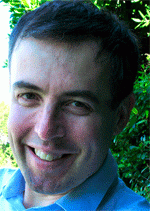
Penelope Todd is a writer, editor and manuscript consultant currently living in Dunedin. She has had seven young adult novels published by Longacre Press, including her Watermark trilogy, and a memoir, Digging for Spain: A Writer's Journey. Her latest novel is Island, published by Penguin (2010), an adult novel.
(Photo of Penelope Todd by Claire Beynon)

Has it been a difficult transition from writing fiction for a young adult audience to writing fiction for an adult audience - and is it a transition you had been intending to make for a while?

I think the transition is proving more problematic for marketers and reviewers than it has been for me. One wrote of my having to 'leap a gulf' but I consider the distinction more or less arbitrary. I've always written what I wanted to write. After seven novels about teen experience, I wrote a memoir in which I outlined the changes, inward and outward, that had been precipitated by so much fiction writing (or that had precipitated the fiction - cause and effect are not easily distinguishable). That seemed to mark a shift also in my method of obtaining the story - as if through the airwaves instead of digging it up from underground - a much lighter process in some respects.

I knew Island would interest older readers so I allowed interactions, events, and my characters' thoughts concerning desire, fate/destiny and mortality (themes evident in all my fiction) to play out more fully. So, no, the transition wasn't consciously made but my characters had been growing older with each YA novel so, looking back, a shift in marketing was inevitable.


When I saw the title of your book, I thought of Quarantine Island in Otago Harbour. Was your own experience of visiting Quarantine Island an important source for the geography and "feel" of the island in your book, even though the location of the titular island is not specified?


We used to hop (in a boat) across to that island - a.k.a. Kamau Taurua or St Martins Island - when our children were young, to stay weekends in the big old house. We'd wander over the hills and shore, pat the donkeys, fish off the rocks and visit the sad little graveyard with its small earth mounds. I absorbed the atmosphere of the place and a sense of its history, and have since overlaid it with my own fictional island and 130-odd years' distance. However, this might be any quarantine island near any colonial port late in the 19th century. While historical accuracy is important, detailed recreation mattered far less to me than the viability of this fictional community, its members, and their relationships.

Penguin's publicity material for Island describes it as "literary fiction of the highest quality, and an intensely romantic page-turner". Do you think that's a fair description of what you are trying to achieve in Island? If so, how easy a balance is that to maintain?

Well, the blurb came later so I wasn't aware while writing of teetering on that particular tightrope. I enjoyed diving into a deeper language pool than I would writing 'current' fiction, and my sentences are always written with an ear to sound and rhythm. Besides that, I hate to bore myself or the reader so the unfolding story is reasonably pacy and yes, there's attraction and desire, a little sex, varieties of love - eros, philia and agape, at least.

As for romantic? I might be happier with the r capitalised. It's not a 'romance novel'. However, a late mountaineering uncle (Colin Todd after whom the hut was named) was recently described as 'a romantic idealist'. That weakness runs in the family. But mixed in with the human warmth generated on the island is the grit of an attempted suicide, a diphtheria epidemic and several deaths. I'll leave readers to judge whether the publicity is fair.

Looking at your entry on the New Zealand Book Council website, I'm intrigued and impressed to see that you recently "travelled to Argentina in order to complete the writing, translation and adaptation of a bilingual novel with Argentinian writer Elena Boss". That sounds fascinating! How did this project come about, and what can you tell us about it?

I can tell you that I feel very privileged to have had this experience. A fuller account of the process is to appear in the next Booknotes, but Elena and I met on the International Writers' Programme in Iowa in 2007 and, in order to keep in touch, wrote a novel together - employing characters from each of our countries, and taking alternate chapters. I met Elena again in Buenos Aires last year so we could firm up our translations. We now have a bilingual novel of which Elena is currently entering the Spanish version in MS competitions in South America before we look for a publisher in English, too. I dare say it's the first-ever bilingual NZ-South American collaborative novel!


In one of your New Zealand Book Month blog posts in 2007, you mentioned the continuing lack of visibility afforded in New Zealand to writers - and in particular woman writers - from south of Christchurch. Quite apart from the inequity of this, it can't help when promoting a new novel. How can this be circumvented?

Oh, sigh. If anyone has answers to this, could they please tell us, and our publishers? Should we move north to where the publishers, the media engines, the book organisations and the money (in Auckland recently, I heard 'super-yacht' slipped into several conversations - what is that?) reside? If it were simply our own invisibility it would hardly matter, but when new work slips through the cracks so quickly, it gets irksome. Getting better at what we do seems not to make an appreciable difference.

There's some beautiful, under-sung writing happening down here, but we get awfully tired of saying, 'It's the process that matters'. Apart from that, I suppose we could all aim to become younger, more attractive, more extroverted... Or, roll on the digital revolution with the democratisation of the publishing process. I'm doing my bit towards that.

Which writers have been most influential on your own writing, and which are your personal favourites? Are there any writers who haven't received the publicity they deserve that you'd like to recommend?

I hate to single out writers down here - too many are friends and acquaintances -but I name a few in the link above. Off the top of my head, I'll be eager and curious to read Emma Neale's and Maxine Alterio's next novels, and Sue Wootton's next volume of poetry. The whole country should be. Thoughtful readers should read Ruth Pettis's two novels. She died two years ago this month - she's really invisible now, but her work ought never be.

Do you have a plan for how your writing career will unfold? If so, and if it isn't a secret, where do you see yourself and your writing in five years' time?


I'm quite a good plodder so I see more fiction unfolding, back and forth in time and place. I always have some longish thing on the go. Meanwhile I want to work more collaboratively so I'm also plodding towards the production of an ebook publishing site - excellent writing carefully selected, sensitively edited and artfully designed, for global sale. But that's complex and I'm learning on all fronts as I tackle the brand new aspects of this project.

How to buy Island

Island is available online from Fishpond. It should also be available at all good independent bookstores, and is available from some Whitcoulls branches.

02 June 2010

Boycott BP? Boycott The Lot Of Them!

There's a "Boycott BP" movement growing on the Internet at the moment - a response to BP's lamentable inability to plug, kill, cap, or otherwise contain their "Deepwater Horizon" oil spill in the Gulf of Mexico.

It's an understandable response, but BP is the wrong target.

Why?

First, BP is hardly unique among oil companies in its arrogant disregard for the environment, human rights, democracy, life, and anything else that gets in its way. A few examples:

But the oil companies behave as they do because we enable them. We use their oil, and as long as we keep demanding more of it, they will keep producing it until it is economically and geologically impossible for them to do so.

Because easily-accessible supplies of oil are fast running out, that means more offshore drilling, more drilling in protected land, in the Arctic, in sub-Antarctic waters. More oppression of indigenous peoples. More greenhouse gas emissions. More power, more money, and even less accountability.

So the answer is not to boycott BP, but to boycott all the oil companies - by using less of the stuff. Not driving when we could walk, bike or take public transport. Not wasting oil on unnecessary journeys.

And, at a political level, lobbying and arguing for better public transport, better support and better safety features for walkers and cyclists, less air travel and more train travel. Less new roads and more new cycleways. And a ban on further deepwater offshore oil exploration and drilling - not least off the coast of New Zealand.

The fault, dear Brutus, is not in our oil companies, but in ourselves.

01 June 2010

Tuesday Poem: Ulysses, by Alfred, Lord Tennyson

Ulysses, by Alfred, Lord Tennyson (1833)

It little profits that an idle king,
By this still hearth, among these barren crags,
Matched with an agèd wife, I mete and dole
Unequal laws unto a savage race,
That hoard, and sleep, and feed, and know not me.

I cannot rest from travel: I will drink
Life to the lees: all times I have enjoyed
Greatly, have suffered greatly, both with those
That loved me, and alone; on shore, and when
Through scudding drifts the rainy Hyades
Vexed the dim sea: I am become a name;
For always roaming with a hungry heart
Much have I seen and known; cities of men
And manners, climates, councils, governments,
Myself not least, but honoured of them all;
And drunk delight of battle with my peers,
Far on the ringing plains of windy Troy.
I am a part of all that I have met;
Yet all experience is an arch wherethrough
Gleams that untravelled world, whose margin fades
For ever and for ever when I move.
How dull it is to pause, to make an end,
To rust unburnished, not to shine in use!
As though to breathe were life. Life piled on life
Were all too little, and of one to me
Little remains: but every hour is saved
From that eternal silence, something more,
A bringer of new things; and vile it were
For some three suns to store and hoard myself,
And this grey spirit yearning in desire
To follow knowledge like a sinking star,
Beyond the utmost bound of human thought.

This my son, mine own Telemachus,
To whom I leave the sceptre and the isle—
Well-loved of me, discerning to fulfil
This labour, by slow prudence to make mild
A rugged people, and through soft degrees
Subdue them to the useful and the good.
Most blameless is he, centred in the sphere
Of common duties, decent not to fail
In offices of tenderness, and pay
Meet adoration to my household gods,
When I am gone. He works his work, I mine.

There lies the port; the vessel puffs her sail:
There gloom the dark broad seas. My mariners,
Souls that have toiled, and wrought, and thought
with me—
That ever with a frolic welcome took
The thunder and the sunshine, and opposed
Free hearts, free foreheads—you and I are old;
Old age hath yet his honour and his toil;
Death closes all: but something ere the end,
Some work of noble note, may yet be done,
Not unbecoming men that strove with Gods.
The lights begin to twinkle from the rocks:
The long day wanes: the slow moon climbs: the deep
Moans round with many voices. Come, my friends,
'Tis not too late to seek a newer world.
Push off, and sitting well in order smite
The sounding furrows; for my purpose holds
To sail beyond the sunset, and the baths
Of all the western stars, until I die.
It may be that the gulfs will wash us down:
It may be we shall touch the Happy Isles,
And see the great Achilles, whom we knew
Though much is taken, much abides; and though
We are not now that strength which in old days
Moved earth and heaven; that which we are, we are;
One equal temper of heroic hearts,
Made weak by time and fate, but strong in will
To strive, to seek, to find, and not to yield.

Tim says:

I like dramatic monologues, a form much beloved of Victorian poets, and this is my favourite. What I like about it, apart from the fantastic lines and memorable images - the section beginning "Come, my friends" most of all - is the intriguing contrast between the jut-jawed Victorian heroism of the poem's surface and the doubt and weariness beneath.

The final line of "Ulysses" stands as Robert Falcon Scott's epitaph, inscribed on a wooden cross on Observation Hill in Antarctica, but in fact the entire poem, in its mixture of doubt and determination, stands as a fitting epitaph for Scott, the "Heroic Age" of Antarctic exploration, and the classical notion of heroism.

Check out all the other Tuesday Poems here.

30 May 2010

SoCNoC: Southern Cross Novel Challenge

The Southern Cross Novel Challenge is the Southern Hemisphere equivalent of NaNoWriMo: a challenge to write 50,000 words of a novel in the month of June. And if that is too much, there's also HalfNoC, 25,000 words during June. If this sounds like you, check out all the details at the Kiwi Writers site. (Thanks to Travis Couttreau for the info.)

29 May 2010

The Saturday Serial: Win A Day With Mikhail Gorbachev, Part III

Part I | Part II | Part III | Part IV

Part III: The Politburo

The Politburo had traditionally met in a sombre, marbled room, sitting six to a side along a massive table. Mikhail felt that this arrangement wasn't conducive to increased productivity and efficiency, so had done away with the heavy table and got everybody to sit in a circle on the ground, on cushions lovingly sewn in one of the more obscure Central Asian republics. The older Politburo members weren't entirely happy about this arrangement, and still grumbled about it when they thought themselves unobserved. However, the younger men (for there were no female members of this most exclusive club) seemed to like the arrangement, and at the moment it was these men - Vorotnikov, Egor Ligachev, Nikolai Ryzhkov, Chebrikov, Eduard Shevardnadze, and Gorbachev himself - who called the shots.

Everyone is in their seats by 2pm sharp, and Mikhail opens the meeting by pinning a big sheet of paper to the wall and asking for agenda items. Ligachev, who has charge of the minutes of the previous meeting, reminds everyone that the Geneva summit and the forthcoming grain harvest are matters that weren't finalised at the last meeting. New agenda items include progress on the BAM rerouting, another increase in funds for technical intelligence, and the colour scheme for the Politburo's new Zil limousines.

The meeting opens with a sharing session, wherein each member lets the others know how they're feeling, so their private, personal problems won't fester unacknowledged beneath the surface of the meeting. Nikolai Tikhonov announces that he has never felt better; Chebrikov winks at Gorbachev. Andrei Gromyko, who has become slightly deaf, queries why anyone would want to feel butter. Shevardnadze, newly appointed Foreign Minister, reveals he's had an exciting day broadening his knowledge of geography, and now knows where Africa and Australia are. Someone whistles a derisory bar or two of "Georgia On My Mind". Generally, everyone has had a good day, although Vorotnikov claims Gorbachev has obstructed him on a couple of key points -then must hasten to explain he is talking about the lunchtime squash game rather than matters of state.

The Geneva summit (where Mikhail plans to try for a propaganda coup by challenging Reagan to see who can stay on a horse the longest), BAM, a 25% increase in funds for purchase of Western microcomputers and microengineers, and the grain harvest (about which there was general agreement that having one would be a Good Idea) are all sorted out quite simply. As everyone fears, the big clash between Gorbachev's new guard and the remaining old-timers comes over the Zils' paintwork.

The matter had first surfaced under Gorbachev's predecessor Konstantin Chernenko, and in keeping with the dour Siberian's approach the normal black colour scheme had been approved. However, Geidar Aliyev had felt even at the time that something more dynamic was called for, and was now proposing a trendy metallic red with racing stripes down the sides. A reliable source who did not wish to be named claimed that Aliyev was originally planning to include mag wheels and furry dice in the package, but decided this might lessen Politburo members' dignity in the eyes of the Russian people.

After Aliyev has put his proposal, there is an uneasy silence in the room. When Gorbachev, who is facilitating the meeting, asks if there is any disagreement, President Andrei Gromyko rises to his feet.

"For 25 years, I was the Foreign Minister of the Soviet Union. For all that time, Soviet representatives maintained the most punctilious dignity and reserve. The western imperialists seek to portray us as barbarians, but we have shown that we are the true standard-bearers of civilisation. Our sober black Zil limousines have been an important part of our image as serious, responsible world leaders. I could never agree to such a proposal."

"Does that means you'd be prepared to block consensus on it, Andrei?"

"Yes, Mikhail, I would."

"Well, does anyone want to try to change Andrei's mind?"

Ligachev, who has a reputation for over-enthusiasm, rises to his feet.

"Listen, Andrei, we're living in the 1980s now, not the 1950s. We're talking marketing, we're talking positioning, we're talking selling ourselves in the marketplace. Today's Politburo needs to project a positive, up-market image, inspiring confidence amongst our customers. Professor Lysenko over at the Soviet Institute of Psychodemographics tells me their latest survey indicates that more Great Russians in the 16-25 cohort know that Wham! recently played China than are aware that the Central Committee recently approved the latest five-year plan. Our collective name-recognition factor, with the understandable exception of Comrade Gorbachev, is less than that of Elton John's percussionist. The citizens of Ust-Kut have recently petitioned to have the name of their main street changed from Lenin Prospekt to Lennon Prospekt! When this sort of thing is happening in Ust-Kut, need I say more?"

(The citizens of Ust-Kut, a small but bustling city in the progressive Lake Baikal region, would doubtless have protested at this implied slur on their modernity, but as it has not until now been revealed, they went about their business in happy ignorance.)

"Egor, interesting as all this is, I don't see why it means we have to have red Zils with racing stripes down the sides."

"Because they're new! They're modern! They're positive! They project the go-ahead image we need. Personally, I'd be prepared to compromise on the racing stripes, but after all, Comrade Gromyko, red is the colour of our Union's flag. Are you suggesting we should change it?"

Mikhail senses that tempers are rising. A good facilitator must be able to strike a balance between non-interference when a meeting is flowing smoothly, and appropriate intervention when things are going off the rails. Now is a time for the latter.

"It's obvious we have considerable disagreement on this issue, and I don't think we can reach a consensus at this meeting. What I suggest is that a few people who've got strong feelings on the issue get together and see if they can work out a compromise proposal, or a new and better one, to present to the next meeting. I won't join that group myself, but stepping outside my role as facilitator I'd like to suggest a dual fleet, one in black for the more ceremonial occasions and one in red, with or without stripes, for trips to the movies and so forth. Are there any volunteers for the working party?"

Aliyev, Ligachev, Vorotnikov and, after some prompting, Gromyko, agree to meet soon to come up with a solution which can be presented to the next Politburo meeting. The present meeting closes with an evaluation; everyone (even Gromyko) agrees it has gone well. Under Brezhnev and Chernenko, everyone would have headed off for a few vodkas at this point, but the fate of Grigory Romanov and other victims of Gorbachev's anti-alcoholism drive persuades them all to settle, in the public interim, for tea, coffee and Milo. After the last cup has been smashed in the fireplace, there's just enough time for Mikhail to pick up his dufflebag from the office before heading home to cook tea.

"Win A Day With Mikhail Gorbachev" was included in Best New Zealand Fiction 4 and then collected in my second short story collection, Transported.

Transported cover

You can buy Transported online from Fishpond or New Zealand Books Abroad. You can also read review excerpts and find out more about Transported

25 May 2010

Tuesday Poem: Impertinent To Sailors

Curved over islands, the world
dragged me south in a talkative year

slipping Southampton
as the band played a distant farewell.

It was better than steerage,
that assisted passage: ten pound Poms

at sixpence the dozen, promenading
in sun frocks, gathering for quoits,

angling, in an understated way,
for a seat at the Captain's table —

while I, a child, roamed decks, became
impertinent to sailors.

And the heat! My dear, there never were
such days — rum, romance,

the rudiments of ska. Panama beckoned,
locks pulsing like the birth canal.

We passed through, to be rocked
on the swells of the quiet ocean,

its long unshaded days
of trade winds, doldrums, Equator —

then a cold shore,
a bureaucratic harbour,

and the half of a world
it would take to say goodbye.


"Impertinent To Sailors" was published in JAAM 27 (2009), edited by Ingrid Horrocks, under the title "Over Islands". I plan to include it in my forthcoming collection "Men Briefly Explained".

Check out all the Tuesday Poems on the Tuesday Poem Blog - including the poem by Kerry Popplewell I've selected as this week's "hub" Tuesday Poem.

22 May 2010

The Saturday Serial: Win A Day With Mikhail Gorbachev, Part II

Part I | Part II | Part III | Part IV

Part II: Arthur C. Clarke

"Arthur C. Clarke, eh, Viktor? How do you rate him in comparison with Asimov?", Mikhail, a subscriber to Analog, asks his security chief.

"Well, as an SF writer, I think Clarke's got the edge. He brings a real quality of transcendence to his best work, so that it attains a numinous quality which belies his claim to be a writer of hard SF. Expedition to Earth showcases this well, I feel - stories like 'Second Dawn', 'Encounter in the Dawn', and, particularly, the title story have a haunting, evocative quality which derives in large part from the revelation of powerful contemporary motifs in unfamiliar and often ironic settings. 'The Sentinel' is of course of special interest as the progenitor of 2001: A Space Odyssey - have you seen the film, Mikhail?"

"I have. Almost as good as Solaris."

"If you make allowances for its crypto-bourgeois philosophy," Viktor said severely.

"But as for comparing Clarke with Asimov - Clarke's a fine writer, but I can't go past the fact that Asimov was born here."

"True, Viktor, although I don't think we should let national chauvinism influence our literary judgements."

"If you say so, boss. Anyway, getting back to Expedition to Earth, there's one story in it which appears particularly relevant in the light of Academician Ivanenko's recent investigations. Called 'Loophole', it's cast in the epistolary form - "

"Letters, right?"

"Letters, yes. It starts with an exchange of missives between the ruler of Mars and his chief scientist. The Martians have just noticed the first atomic bomb test here on Earth, and - well, perhaps you'd like to read it for yourself, Mick?"

As Mikhail Gorbachev reads of the Martians' plans to dominate and eliminate the humans through their control of interplanetary space, and of the loophole through which the humans strike first, Viktor Chebrikov's gaze strays to the window at the other end of the room. On the other side of that window, the Lubyanka waits to receive its unwilling guests, three faceless bodies lie just beneath the melting snows of Gorky Park, and Arkady Renko and a small group of friends sit watching a smuggled videotape of Hill St. Blues.

In the snows east of Irkutsk, workers on the Baikal-Amur Mainline take care to prevent their skin freezing to the track, and in the Tunguska the trees are again laid flat. Nude bathers are causing a stir in certain Black Sea resorts, whilst in a dacha just outside Moscow Nikolai Tikhonov gives his all in the arms of his beloved as KGB cameras record the scene for posterity.

And more coffins return through the mountain passes from Afghanistan, and Vladimir Arsenyev roams through the taiga with his friend Dersu Uzala, and Stalin's daughter leaves and returns in pain, over and over, as the birches nod their heads in the breeze above the rich black Russian soil.

Mikhail Gorbachev finishes reading. "Hmmm, matter transmitters, eh? What a bright spark that Arthur C. Clarke is. Well, Viktor, any other news? Can my doctors be trusted?"

"Not a disloyal thought in their heads, Mick. I think you're safe there. But I must be going. I have an ethnic minority to oppress."

"Which one?"

"Why, the Russians, of course!"

"One of these days we'll have to stop laughing at that joke. Well, Viktor, show that story to our good friend the Marshal. Our team at Tyuratam may be able to make something of it."

"O.K., boss, I'm away. See you at the Politburo meeting."

Mikhail spends the rest of the morning going through his paperwork and reading his mail; there are five circulars, two chain letters, one misdirected subscription to Krokodil and no invitations to the Vatican. At lunchtime, there's time for a brisk game of squash with Vitaly Vorotnikov before the 2pm Politburo meeting.

"Win A Day With Mikhail Gorbachev" was included in Best New Zealand Fiction 4 and then collected in my second short story collection, Transported.

Transported cover

You can buy Transported online from Fishpond or New Zealand Books Abroad. You can also read review excerpts and find out more about Transported