


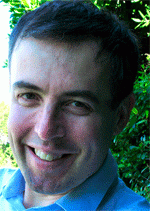

This afternoon I took part in a live discussion on science fiction and fantasy writing in New Zealand. Chaired by Radio New Zealand's Lynn Freeman, it featured writers Helen Lowe, Russell Kirkpatrick and myself, and publisher Larain Day - see below for further details.
The podcast of this 13-minute discussion is now available in MP3 format at http://podcast.radionz.co.nz/art/art-20090712-1430-Chapter_and_Verse-048.mp3
I enjoyed taking part - and thanks for inviting me, Lynn - but I felt we were just getting started on the discussion when we ran out of time. All the same, we covered some interesting territory, including whether New Zealand SF&F readers are willing to read SF&F written by New Zealand authors and published in New Zealand, and where these genres may go in future. Worth a listen, I think!
12 July 2009
Chapter and Verse: Podcast Discussion on New Zealand Science Fiction and Fantasy


09 July 2009
Ain't No Stopping Us Now
Hard on the heels of the news that a short story collection by science fiction writer Chris Beckett has won the prestigious Edge Hill Short Story Prize, beating collections by Anne Enright, Shena Mackay, Ali Smith and Gerard Donovan, comes the slightly less big - but still welcome - news that Radio New Zealand (National Radio) is holding a panel discussion this coming Sunday afternoon (the 11th) on writing science fiction and fantasy. Here's the official announcement:
2:30 Chapter and Verse
A panel of New Zealand Sci-Fi writers and publishers, on the on-going fascination with the future, and what the future holds for our Sci-Fi. On the panel are writers Tim Jones, Helen Lowe and Russell Kirkpatrick, and publisher Lorain Day from Harper Collins.
(Ooh, I do dislike that term "Sci-Fi"! It always sounds patronising to me - but I'll learn to cope...)
Two of the panelists, Helen Lowe and Russell Kirkpatrick, are best known for their fantasy novels (though Helen is also an excellent short story writer and poet), so I expect to be holding the fort for science fiction and for short fiction.
If you live in Wellington, keep your eyes peeled for another writing event in September featuring Helen Lowe and myself - more details to follow!
Details of how to access Radio New Zealand broadcasts are available on their site (see "Ways to Listen" on the bottom left of the home page) and, if a podcast is made of the panel, I will put the link up here as soon as it's available.
06 July 2009
Consult and Survive: The First Session
I've just come back from the first session of the New Zealand Government's consultation meetings on New Zealand's greenhouse gas emissions reduction target for 2020.
Climate Change Minister Nick Smith was faced with an audience of between 300 and 400 people. After his twenty-minute presentation, doing its best to send a message of "we'll sign up to a target, but don't expect it to be substantial", members of the audience had the chance to speak — and, one after another, they implicitly or explicitly supported New Zealand taking on a strong reduction target in Copenhagen, with most of them plumping for the target to be a 40% cut in 1990-level emissions by 2020.
The Minister's response was interesting. He stayed in his seat after most of the speakers, and when he did take the stage, he claimed that a 40% cut was too difficult because the fact that agriculture is responsible for 50% of New Zealand's greenhouse gas emissions meant that no emissions would be allowable in all other sectors if we adopted a 40% by 2020 target.
There was a glaring hole in this response: it assumed that no emissions reductions were possible in agriculture. This is patently untrue: in fact, many farmers can make a profit while reducing emissions by using nitrification inhibitors, as revealed by the Sustainability Council.
So why don't they? Part of the answer is that they are under the sway of their leadership, Federated Farmers, who are so opposed to taking responsibility for farming's share of greenhouse gas emissions that they have called for agriculture to be completely excluded from New Zealand's Emissions Trading Scheme.
Fed Farmers are only one of a number of powerful lobby groups - others include the Major Electricity Users' Group and the Greenhouse Policy Coalition - which have spent a lot of time and money trying to prevent New Zealand taking any effective action on climate change. These groups are too clever to deny the science of climate change - instead, they argue that it would cost New Zealanders too much to take action. What they really mean, of course, is that it is their members who are responsible for the bulk of New Zealand's greenhouse gas emissions, and therefore their members who would have to start paying.
I was forcibly reminded of this, because I happened to sit behind the the main lobbyists from two of these groups at tonight's meeting. They didn't get up to speak. They didn't state their real views. But they were listening, carefully, and no doubt working out the arguments they will use behind closed doors to try, yet again, to prevent the New Zealand government getting serious about climate change.
When I left the meeting, the speeches from the floor were still continuing, speaker after speaker making passionate, well-informed calls for action. And the lobbyists were still sitting quietly, saying nothing and taking in a lot. The constrast symbolised why these meetings are so important. For most of the time, the well-funded lobbyists have the Minister's ear. But tonight, and for the next twelve nights, it's the public turn.
Find out when the meeting is in your town. Get along and call for serious action on climate change. Challenge the Minister when he tries to leave agriculture out. And don't let the lobbyists have it all their own way.
UPDATE: Joshua Vail has posted a full report of the meeting, with video links to Nick Smith's presentation and people's responses. It's at http://www.joshuavial.com/wellington-consultation-for-2020-emissions-target/
UPDATE 2: 350.org.nz is posting summaries of the consultation sessions on their home page - scroll down to see them. I'm pleased to see Dunedin went so well!
05 July 2009
Consult and Survive
Twelve days. That's how long the Government has allocated to the public consultation process to decide what greenhouse gas emissions reduction target for 2020 New Zealand will take to the Copenhagen climate change negotiations at the end of 2009.
There have been many international climate change negotiations down through the years, but the Copenhagen negotiations are shaping up as the most significant since the Kyoto negotiations that led to the much-debated Kyoto Protocol. The prognosis for the global climate and for sea-level rise has got much, much worse since the Kyoto Protocol was signed - but the world's knowledge of that predicament has also grown much greater.
I could write a lengthy explanation of what these consultation meetings are about, and why it's so important that many voices call for steep reductions in New Zealand's greenhouse gas emissions by 2020 - to be precise, a 40% reduction on 1990 levels by 2020. But Greenpeace have done that already, so, with due thanks and acknowledgement to their Sign On site, here are the key things to know about the consultation sessions, including the schedule.
From http://www.signon.org.nz/blog/government-s-copenhagen-target-consultation-starting-next-week-have-your-say:
In December governments will converge at Copenhagen aiming to reach a new climate agreement and urgent and ambitious reductions are being encouraged by climate scientists.
The Government hasn’t given the NZ people much time to have their say on this crucial issue. But we still see it as a good opportunity for people to get vocal about the target that New Zealand needs to set – 40 percent by 2020. Government Ministers will take just two weeks to visit only nine centres in New Zealand to hear what the public think, starting Monday!
We need to mobilise as many people as possible to attend the meetings and show their support for 40 by 2020 targets.
Sign On supporters will be out front of the meetings beforehand each night signing people on and also distributing stickers that people can wear into the meeting showing their support for the needed 40 percent by 2020 target.
Times and venues:
* Mon July 6 – Wellington – 7.30pm – 9pm, Oceania Room, Te Papa.
* Tues July 7 – Auckland – 7.30pm – 9pm, Princes Ballroom B and C. Hotel Hyatt Regency, Corner of Princes Street and Waterloo Quadrant, Auckland Central.
* Wed July 8 – Christchurch – 7.30pm – 9pm, Hall C, Convention Centre, Kilmore Street,
* Thur July 9 – Dunedin – 7.30pm – 9pm, Clifford Skeggs Gallery, Dunedin Centre, 1 Harrop Street, Dunedin
* Friday July 10, Queenstown – 7.30pm – 9pm, Icon Room, Heritage Hotel, 91 Fernhill Drive.
* Monday July 13 – Hamilton – 7.30pm – 9pm, Waikato Room, Sky City Hamilton, 346 Victoria Street, Hamilton
* Tuesday 14 July – New Plymouth – 7.30pm – 9pm, Conference Room Plymouth International, Corner Courtenay and Leach Streets, New Plymouth
* Wednesday 15 July – Napier - 7.30pm – 9pm, Ocean Suite East Pier, Hardinge Road Ahuriri, Napier
* Friday 17 July – Nelson – 7.30pm – 9pm, Waimea Room Rutherford Hotel, Trafalgar Square, Nelson.
The consultation won’t be the final word on the target. This is simply to find New Zealand’s opening offer at the international negotiations. Let’s make it as strong as possible. We’ll be campaigning for 40 by 2020 right up to the last second of the last day because the future of the planet isn’t up for negotiation.
Internet based consultation for those who can’t attend
You can submit questions for the Minister for Climate Change Issues' online video conference to be held from 7.30pm on Monday 20 July at www.r2.co.nz/20090720. Questions can be submitted in advance by email to 2020target(at) mfe.govt.nz
You can also email the Minister with your views to nick.smith (at) ministers.govt.nz
Tim adds: If you're not closely involved in climate change issues, the parade of meetings and negotiations can soon become mind-numbing - in fact, it confuses me, and I am involved. But this meeting, and this target, really are important. Time is running out for a liveable global climate. The Government, after initially believing it could sideline the issue, has now discovered it can't. Elements within the Government want to take meaningful action on climate change, and other elements want to block meaningful action. As many people as possible need to get along, call for deep cuts, and stiffen the Government's sinews so that it opts to become a part of the solution rather than remaining part of the problem.
02 July 2009
The Stars Their Destination: Wellington, Palmerston North, The Edge of the Universe
2009 is the International Year of Astronomy, and so it's fitting that there's an astronomical theme to several forthcoming writing events. (If you know of more astropoetry events, please tell us about them in the comments.)
If the combination of poetry and astronomy interests you, then I recommend Emily Gaskin's Astropoetica, not only a fine online magazine of astronomical poetry, but a paying poetry market!
Wellington
Montana Poetry Day events in Wellington on 24 July include an all-day open mike poetry event in Cuba Mall, by the Bucket Fountain. But I'm especially interested in the lunchtime event:
There will also be an Astropoetry Lunch Hour celebrating the International Year of Astronomy during which poets can read any ‘astronomy’ themed poems.
Open to all; free entry. Contact Graham Wolf on graham.w.wolf (at) gmail.com
Palmerston North
Helen Lehndorf and the other organisers of the Stand Up Poetry series in Palmerston North are also involved in this exciting event:
Eyes in the Skies: Poetry and art for Matariki
"Eyes in the Skies" is both an exhibition and an event. The exhibition runs from 3 July (launch at 7.30pm) to 4 August at the Square Edge Gallery, 47 The Square, Palmerston North. It features poetry by Helen Lehndorf, Margi Mitcalfe, Karlo Mila, Johanna Aitchison, Felicity Yates, Philippa Elphick and Elizabeth Coleman, and art by printmaker Virginia Jamieson and sculptor Warren Warbrick.
The Poetry Day event is from 5.30 pm onwards, Friday 24th July 2009 at Square Edge:
Using nga taongapuoro and voice, HAUnt Wind Stories presents an evening of music showcasing new poems by seven Manawatu poets including Karlo Mila and Johanna Aitchison. The poems will be made into prints by Virginia Jamieson and unveiled during this event. The poems and prints will also be sold in book form at the event.
Open to all. Email HAUnt (at) inspire.net.nz for further information.
Tim Upperton's Book Launch
I don't know of an astronomy connection to Tim Upperton'sbook, although there may well be one - but Tim's a fine poet (and a gracious host), and his first collection of poetry, A House On Fire, is being launched, also on Poetry Day in Palmerston North: it's happening at 7pm on Friday 24 July at the Palmerston North City Library, also in The Square. A House On Fire will be introduced by Roger Steele of Steele Roberts, who are publishing the book.
Another commitment will prevent me from going to this launch, but if you can make it, you should!
The Edge of the Universe
The Royal Society's Manhire Prize for Creative Science Writing is awarded each year in two categories, fiction and nonfiction. Here is this year's announcement:
"I live at the edge of the universe, like everybody else."
--Bill Manhire
This year we are celebrating the International Year of Astronomy. Ever since Galileo first aimed his telescope at Jupiter's moons, technology has been enlarging our knowledge of the universe.
We now know our own insignificance and isolation and yet we have immense power to communicate as never before. The race of humans is isolated in space and time and yet where, as individuals, do we go to be alone?
A cash prize of $2500 will be awarded to the winner of each category. The closing date for entries is Tuesday 22 September 2009.
The Manhire Prize for Creative Science Writing is organised by the Royal Society of New Zealand in association with the New Zealand Listener magazine and the International Institute of Modern Letters at Victoria University of Wellington.
For more information, terms and conditions and entry forms visit http://www.royalsociety.org.nz or contact: Danae Staples-Moon, ph 04 470 5770 or email danae (at) royalsociety.org.nz
29 June 2009
Coming Attractions, Bloggy Goodness, and A Little Bit of History
As Helen Lowe pointed out to me recently, I haven't run many interviews with poets on my blog this year. But this is about to change! Because Montana Poetry Day is on Friday 24 July, several poetry books are being launched on or about this date, and I will be interviewing three poets with books just on the shelves: Mary Cresswell, Joanna Preston, and Tim Upperton. I'm also going to review Mark Pirie's verse novel Tom.
As promised in Part 1 of Down in the Flood, I'm going to marshal my thoughts on the topic of creative writing about climate change, and I am hoping to have another guest blogger add some informed comment to my usual wild speculation in the fairly near future.
And, of course, I'll fill up the remaining posts myself with a tantalising mixture of celebrity gossip, multi-level marketing schemes, and anecdotes about our cat. Who is good at catching mice, but less good because she keeps insisting on bringing them inside and releasing them in our lounge.
Hello, Bloggy Goodness!
In the left column, you'll find links to a lot of fascinating blogs, both New Zealand and international, which I try to visit and check out when I have time, either directly or through Google Reader. One day, I'll add a list of blogs with recent updates, but that time is not yet.
I don't have time to visit half the blogs I would like to half as often as I'd like (to misquote Bilbo Baggins), but here's a few I've found myself drawn to lately (in addition to blogs I've previously posted about here and here and here and all the way back to here):
- Jack Ross doesn't post often, but what he does post is usually fascinating. I found his recent post on the Tolkien industry especially interesting.
- Thoughts from Botswana, by Lauri Kubuitsile, is a fascinating insight into living and writing in Botswana.
- When it comes to the hard, cold practicalities of commercial publishing, there are few places more reliable - and at times more sobering - than Jane Smith's How Publishing Really Works.
- And here's an even scarier blog for writers trying to get publishers and agents interested in their work!
- Kay McKenzie Cooke is a fine poet whose blog made for weather is not only interesting to read, but lavishly illustrated. A thing of beauty!
A Little Bit of History
There's a historical writing competition on in my old home town, Gore. Here are the details (thanks to Rosemarie Smith for this information):
WIN HAMILTON MEMORIAL AWARD FOR HISTORICAL WRITING
GORE HISTORICAL SOCIETY
Buildings, Businesses, Breadwinners and By-standers
If buildings could talk, what stories would they tell?
Entries should be essays of 1500 words or more, with photographic illustrations if possible, on a topic relating to a specific building or business in Gore, Mataura or the rural districts. Essays should contain some original research, and preferably have some emphasis on the period 1930-60.
Entries to be delivered to:
Gore Historical Society
16 Norfolk Street
or
PO Box 305
Gore
by 21 September 2009
There is one remaining workshop to assist with research and writing: Tuesday 23 June and 21 July at 7.30pm, St Andrews Hall, Gore
Further information: 208 7032 or 208 4822 or heritage (at) goredc.govt.nz
25 June 2009
Down in the Flood (1): Going Under
Well it's sugar for sugar and it's salt for salt
If you go down in the flood it's going to be your own fault (Bob Dylan)
As a writer, I spend quite a lot of time flooding things. In my poem First Light, I flooded a fair chunk of the Manawatu. (I read this poem in Palmerston North, and it didn't prompt undue alarm.) Several stories in my recent collection Transported feature the rising, or risen, sea:
I cut the engine in the shadow of the motorway pillars and let the dinghy drift in to the Wadestown shore. The quiet of late afternoon was broken only by the squawking of parakeets. After locking the boat away in the old garage I now used as a boatshed, I stood for a moment to soak in the view. The setting sun was winking off the windows of drowned office blocks. To the left lay Miramar Island, and beyond it the open sea. (The Wadestown Shore)
He started to walk towards the headland at the northern end of the beach, wondering whether the stream was still there. It was, but it now flowed out through a stop-bank that protected the fields behind. Someone – maybe the farming family that used to live here - had put a lot of work into that bank, but it had not been maintained lately, and the cracks were beginning to show. Soon the abandoned fields would become swamp and then lagoon. Mangroves would grow here for a while, until the sea rose too high even for them. (Going Under)
I think there are several reasons why flooding features so prominently in my work. One is that I spent a lot of time on or near the water as a child. My family emigrated to New Zealand when I was two, and later on, my dad got a job as a fisheries inspector. While he chased after paua poachers and the like, I would dam streams on the beach, a vocation commemorated in this little prose poem:
Bluecliffs Beach
The boy plays in the sand. His father, the inspector, has been gone for two hours, checking paua, checking crayfish, checking for bad men sifting the tide.
The boy is damming streams. They flow down from the blue cliffs, over the road, and into Te WaeWae Bay. Except for one: the stream the boy has dammed. The water pools, goes wide, searches for a way. The boy is ready. He has driftwood, he has sand. One day he will be the greatest hydro engineer the world has ever seen. The Waiau, the mighty Clutha: none will flow free of his reach for long.
His dad returns. No bad men today. They drink coffee from a thermos, taking turns with the single cup, then walk back to the van. The boy looks back. The wind, the sun, the tide, the stream, the sand.
(from Southern Ocean Review 43)
Next, there's my interest in climate change. Writing creatively about climate change in general isn't easy - something I'll talk about more in the second part of this post, when I've figured out why! - but the rising sea can be powerful in a story, both as an actor in itself and because it stands in so well for fate. "No fate but what we make," says the Terminator franchise, but the sea is ever-present, inescapable. It's coming for you.
The third reason is, again, personal. In 1989, I nearly drowned when swept off my feet at Smaills Beach, near Dunedin. I was saved by good fortune and the swift action of friends, to whom I am very grateful. That near-drowning has turned up several times in my work, most recently in "Going Under" in Transported. So, if you'd prefer to avoid the trouble and inconvenience of such an experience, this is what it felt like to a thinly-disguised me.
From "Going Under"
Martin lay on the beach for a while, talking with his new flatmate Chris. But the sea looked inviting, and he dragged himself out of the sandhills and down to the water’s edge. He dipped his toe in, and decided the water was getting warmer by the year. Of course, seasonal fluctuations were always — Stop thinking, Martin, he told himself, and get in there! He advanced to calf-deep, to thigh- and hip-deep (postponing the inevitable shock when the water first touched his balls); he savoured the ebb and surge of the streaming water.
When the troughs of the swells were reaching his chest and the crests were lifting the hair from his neck as he turned to let them pass, he decided that he’d come far enough, and started back. Turning, he was caught off-balance by an incoming wave approaching the beach on an angle, warped by the longshore current. It washed him off the sandy hummock on which he had been standing and deposited him on the floor of a pit almost a metre deeper. The water climbed above his shoulders and his head. Only his frantically waving arm broke the surface.
He had a couple of minutes to live. He leapt upwards; his head breached the surface, and he took a mouthful of foam and air. No-one was nearby. He yelled, but the water swallowed his cry and surged into his lungs. Another jump, a half-breath, then a wave broke over his head and he was submerged again. A third jump; this time, he barely broke the surface before falling back.
Martin was well under this time, and his legs were tiring. He tried to make the air in his lungs last and even had time to look about him. Despite his panic, he noticed the colour of the light - Steinlager green - and the hummocks on the sea floor. I’m going to die here, he thought. Water and bubbles flashed before his eyes. He could feel himself fading. Well, one last jump for old times’ sake …
The current was an impartial thing. It had prowled that shore for ages, carving out headlands at the northern end of each beach, working with the waves to scour the bottom. It had swept him out of his depth, and with his life some thirty seconds from its end, as he tried one last jump for air, it swept him out of the pit and back onto higher ground. His head rose above water; he breathed raggedly, coughed up a specimen of the brine that had nearly claimed him, and staggered towards the shore.
Stories excerpted in this post are from Transported: Short Stories (Vintage, 2008). You can buy Transported online from New Zealand Books Abroad or Fishpond.