14 August 2012

Tuesday Poem: The Wind Blew Back Biff Byford's Hair


We stand in the face of the wind, of the wind machine
Our stylists ready with product and comb
We take up our stance and seize our guitars
In the face of the wind, of the wind machine.

We sing in the face of the war, of the war machine
Our stylists ready with product and comb
We watch the director and follow his cues
In the face of the war, of the war machine.

We laugh in the face of death, of the death machine
Our stylists ready with product and comb
We tease out highlights and re-shoot some takes
In the face of death, of the death machine.

We sneer in the face of hate, of the hate machine
Our stylists ready with product and comb
We shout out to fans who've stayed staunch and true
In the face of hate, of the hate machine.

In the face of hate, in the face of death
In the face of the war, in the face of the wind
We take up our stance and seize our guitars
Our stylists ready with product and comb.

Credit note: This is one of the poems I cut from the final manuscript of Men Briefly Explained. It is published here for the first time.

Tim says: You will scarcely need reminding that Peter Rodney "Biff" Byford was the magnificently-maned lead singer of Saxon, one of the bands that came to prominence in the New Wave Of British Heavy Metal, or NWOBHM as one should properly call it (Nu-wobbem).

Here's Biff's barnet getting a good workout in an otherwise rather dubious hair-metal cover of Christopher Cross's yacht-rock hit "Ride Like The Wind"from 1988: http://www.youtube.com/watch?v=E0OFr3-JPSE

After Billy Collins invented a parody of the villanelle called the Paradelle, I felt I had to go one better (or worse). I call the form I have invented for this poem the "Paradiddle", and hope that more poets will take up the challenge to write in this form, especially when writing poems about the lesser bands of the NWOBHM era.

My poetic tribute to the St Valentine's Day Massacre EP by the combined forces of Girlschool and Motörhead, should it proceed, is almost certain to be in the form of a paradiddle. I plan to call it "Please Don't Touch": http://www.youtube.com/watch?v=D5dAyPoYax4 (R.I.P. Kelly Johnson, sadly missed).

The Tuesday Poem: can be found in all its multifarious splendour on, and in the sidebar at the left of, the Tuesday Poem blog.


07 August 2012

Tuesday Poem: tusitala of white lies, by Iain Britton


a million blackbirds

      fling full stops at the horizon


but who do I prefer to believe –

  the lady in black feathers

           who owns and occupies

                   a fig tree

or the slothful bugger

     who lives in the letter box

posting mail to himself           

          or the toilet roll author

                    of Kingdom Street

           the tusitala of white lies
        
                    of uninhibited wafflings /       


the view from here

            is global / inviting


                   extinct frogs

       continue to purse their lips

to chirp (bird-like) through solitary séances


                 the moon’s /          a cold lump

stuck hard

and helmeted

         
              but I prefer              the brunette

                       her feather cloak

                    her moulting shadow         her strut


          I coax her to come in

               share the dilated vista of another’s reality


I’m the tourist guide bus driver jesus janitor / the son
reorganising the future footprints of a family yet to cement
its language in stone in grubby layers broken like old teeth

another thing?

I walk through my house every day

to the sound

                of water music

                a forest shuffling its roots

                doors opening shutting

                a mango melting at the altar of my mouth


but then

               not all is at right angles

                             all isn’t the perfect hideout

                          for this fresh-air junkie

                   contemplating

               a dreamtime jaunt
            
               an astral flight /    
               with no strings dangling


loose-limbed haloes

                       break down
                       dissolve

            reviving an animal magnetism


      I retreat into the hood of my consciousness

                      groping for the lady’s

                            anatomy

             her tightening grip – this flesh

                         and blood

                               mix of polarities


Credit note: "tusitala of white lies" is the title poem of Iain Britton's latest collection, a poetry pamphlet published by Like This Press in the UK. It is reproduced here by permission of the author.

Tim says: Iain Britton is a fine New Zealand poet whose work deserves to be better known. I interviewed Iain in 2009 for this blog, and since then, he's continued to have success publishing his work both in Aotearoa and internationally, as his bio shows:

Oystercatcher Press published my 3rd poetry collection in 2009, Kilmog Press my 4th in 2010. The Red Ceilings Press and the Argotist have recently published ebooks. A full collection with Lapwing Publications is out now, plus a pamphlet from Like This Press. Beard of Bees (US) chapbook in now online. Forthcoming  - poems in Peter Hughes' Sea Pie: a Shearsman Anthology of Oystercatcher Poetry. Also, Department Press and The Gumtree Press will be publishing collections later this year or in 2013.

The Tuesday Poem: Check out today's hub poem, and all the individual Tuesday Poems linked from the sidebar to the left, on the Tuesday Poem blog.


02 August 2012

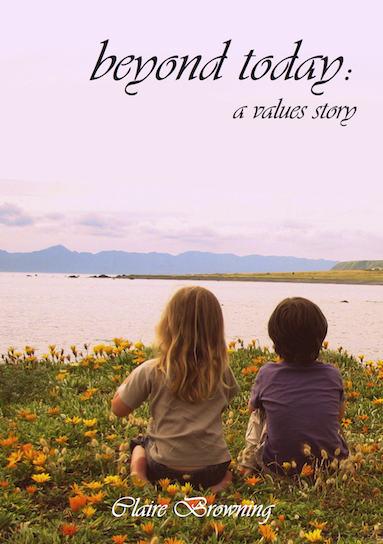
An Interview With Claire Browning

Claire Browning is a former lawyer, author, editor and policy analyst, turned conservation advocate for Forest & Bird. She has also written regularly for blog site Pundit on environment and conservation issues, and green politics. Beyond Today is her first book, although she’s been published on a number of previous occasions, as co-author of Adams on Criminal Law: Sentencing, and in law reform reports and law journal articles. Wairarapa-based, she is renovating a cottage, growing a food forest, and cultivating wildness in her garden.


How did you come to write Beyond Today: a values story?

Well ... there’s a bit of a story there. I’d been blogging for a while on Pundit. Jeanette Fitzsimons was leaving Parliament, and I wanted to write a valedictory post – and to do that, I wanted to see the trajectory of her political career. Jeanette lent me her two Values Party manifestos: Blueprint for an Alternative Future from 1972, and Beyond Tomorrow (1975).

They were what I’d been looking for from the Greens: the key to the policy puzzle. And so, I wrote some blogs about Values, and about Green policy, nagging the Greens about their story. That’s where it started, and in the end, I wrote the story myself. The result is Beyond Today.

I worked hard to boil it all down to its essentials; to keep it short and clear and simple; to make it approachable; and beautiful enough to do justice to an amazing political story, and a compelling policy one. But so much more could be written, about the history of the Values Party, and the green movement, and the way forward.


If you don’t mind me asking, what led to your personal decision to join the Green Party?

It was a – I won’t say reluctant – but a cautious decision. I joined with a personal commitment not to participate in any of the party processes, as an inside observer, for research. I couldn’t find out what I needed to know or wanted to understand about the party, without a better sense of who its members were and how processes worked internally.

At the present time, my membership’s expired.


Beyond Today is in part a history of the Values Party, and in part your thoughts on the future of the Green Party. Was it always the intention to cover both these aspects, or did that combination develop as the book progressed?

It was always the intention to cover both - to take a perspective on the Greens by looking back at Values, to move policy and politics forward. But I want to correct this idea of the book as a “history” of Values. It isn’t, and it’s title – Beyond Today: a values story – is values with a little “v”.

It sketches out how the Values Party started, and some of the things that it achieved. I wanted to pay tribute to the Values movement, and say to the Greens: let’s celebrate being 40 years out in front. It’s a plea: don’t let that story get lost. The green movement was grounded in values, and values are what need to change. So I’m less interested in the history than the story for today: what being green really means, and why.

I wanted to challenge the Greens, too: to shake out a bit of the righteousness.


Given the often-tempestuous history of the Values Party, did you find that former Values Party members were keen to talk with you for this book?

I gather that a few more of them wanted to talk to me than I had realised! Perhaps it’s a consequence of the tempestuous relations and different perspectives that people wanted the opportunity to offer their own views.


In contrast to the Values Party (of which I was a member from 1977-1980), the Green Party seems for the most part to have maintained a high degree of unity, and when splits or potential splits have occurred, they seem to have been well managed. What do you think accounts for that contrast?

I think that the party has learned from its history. Its first co-leaders Jeanette and Rod were former Values members, as were others. But also, I suspect it’s been attained in large degree by simply muddling, as a party, along through the issues; I don’t mean by that to belittle anyone’s political management, or the care that’s probably from time to time gone into political management, but there’s been muddling, too, on policy in particular.

There’s always going to be a risk that in becoming more definitive, it’ll alienate some people. One description that resonated with me was of the party as a sort of Rorschach blot, on to which members, candidates, voters project their own perceptions, and their different (though not incompatible) priorities, and can rub along quite happily together for quite a long time, in a culture of respect and tolerance. But when it comes to a broader audience - and winning hearts, forever, not just a vote and power for a few years - I don’t know if that’s enough.

I may be wrong. But it became important to me to write the story down again, in 2012 not 1972 - to say what it is that green politics actually represents, not just a cleaner environment. By far the largest part of the challenge – and it’s the same challenge – is the economics.


In Beyond Today, you appear to be arguing that the Green Party would be better served by not being identified with the left of the political spectrum. Is that a fair statement of your position?

Yes. And I think there are both political reasons, and reasons in principle.

Values dismissed the politics of both the right and the left, and others share Tony Brunt’s hunch (Brunt was Values’ founder): that there are a lot of voters with a collection of values that coincide with the mix of policies that you would find, and have always found, in a green manifesto – voters who don’t and won’t identify with the left – because they aren’t intrinsically left-wing values. Green politics hasn’t tapped into that movement yet. It might be starting to.

In the end, I think you can express it very simply. This is not about two-dimensional opposition politics. It’s about all of us, and all of the kinds that it takes to make a world. It’s about supporting and demanding individual responsibility and freedom, just as much as supporting a strong social structure, and regulation to protect those without a voice in society: nature and the disenfranchised. And it will take all of us.

There are right wing values that are not admirable – they’re disastrous – but there’s ideology of the left that will see this project fail, if we can’t practise inclusion and diversity, instead of just talking about it.


In my view, our core problem as a species is that we are living beyond the planet’s means – we are using up the Earth’s natural capital faster than it can be replenished. I don’t think that it is possible to establish a global economic system that allows us to live within the planet’s means under capitalism, because capitalism depends on economic growth. Does the Green Party share that position, and if so, doesn’t that make the Greens an anti-capitalist party?

I think you need to ask a spokesperson for the Green Party! But the best response to that which I’ve seen to date, about a managed transition to something else – as yet undefined – would be Jeanette Fitzsimons’ on Pundit:

If you were designing a system to live within the limits of the planet and care for all its people you certainly wouldn't start with capitalism. But given that's what we have, and the only thing most people know, and change is desperately urgent, like in the next 5 years - what do you do with it? What happens to the corporates which currently deliver the goods and services we buy and in which many small people have invested their life savings? They aren't going to just go away and there's no appetite publicly for recolution and confiscation and nationalisation. I'm afraid that if we have to wait to change the whole economic system and grow a form of democratic eco-socialism that has never been tried anywhere let alone succeeded in leaving us a blueprint, we will still be designing it when the oceans close over our heads and food wars break out all over.

Of course it would be better to run society as a participatory, democratically controlled egalitarian economy that plans to meet human needs sustainably, but the big problem remains. What seem like the obvious priorities to us - quality food and shelter for everyone, products that last for ages and can be repaired, renewable energy, local production - just aren't the priorities most people would choose. We assume a democratically controlled socialism would give us the answer we support - where is the evidence for that? And if the people, given all the facts, choose more shopping malls and one trip packaging and junk food and waste, because they have endured generations of advertising and corporate culture that inculcates those values - what then? and how likely are they to choose to limit their own consumption even more severely so that people in developing countries can get enough food and fresh water?


It was in the context of a discussion, and people might want to read the whole thing. I don’t think we know yet exactly how a functional green economy would look.


The current relationship between the Green Party and the Labour Party is a curious mixture of cooperation and competition. To what extent do you think the two parties can – or should – find common ground? How about the Greens and other parties?

Yes, “hugging” or “mugging”? I was intrigued by Grant Robertson’s recent speech: the latest in a series of indicators that Labour, as it has always been, is quite attentive to the Greens’ approach, and green ideas. He gave the speech on June 28 - it’s a thoughtful speech - and like Beyond Today, it’s about values. Labour values, starting with the Labour constitution.

But Labour’s also missing, or not fully addressing, a very fundamental point, and I suspect this is a consequence of the point having been so obscured – the key point I try to tease out in Beyond Today. There won’t ever be common ground, until the economic paradigm of growth shifts. The environment part can’t be done, without the economic part. Anyone who says it can is lying.

There are parts of green thought that express both left and right wing ideals, which the politics chapter of Beyond Today explores a bit. And there are parts so incompatible with both that the ground is not common. It’s not common at all, in any sense: it’s not shared by anyone else yet, politically, and it’s an elusive, radical (transformational) thing.

I guess that means by definition, it can’t be the centre ground.


As someone who’s both an environmental activist and a poet, and who finds that the two roles don’t always fit neatly together, I am intrigued by your statement, echoing Paul Kingsnorth, that “we need the quants, and the poets, both” (p. 107). Who do you mean by “the quants”? And how can the poets help without losing their poetry, and turning into mere propagandists?

“The quants” is Kingsnorth’s term. It comes from a blog that he wrote, I’ve quoted from it in the frontispiece of the book, and the whole thing is among my favourite blog reads.

My understanding of what he means by that term is: people – well-meaning people, politicians often, but not exclusively – who have lost sight of, or forgotten, or never understood what lay at the heart of green thought. People who are focused on making the $ and the carbon cuts (and the votes) add up; less focused, if at all, on confronting the whole economic paradigm, and confronting ourselves.

He rightly pinpoints the fact that we need a whole culture change, a total change of heart. And that one of the ways, perhaps the only way, to achieve that is by changing the stories we tell ourselves, about ourselves. Which is where the poets come in. The Club of Rome’s saying the same thing (the Club of Rome, a high-powered think tank, first published the Limits to Growth in 1972).

I’m both: quant and poet, both. Not, literally, a poet - but I analyse (law and policy, usually), and when I get tired of that, I dream. Perhaps that’s an uncomfortable mix in the book, I don’t know, nor care really. It is what it is, and how I wanted it to be. It’s the story, according to me.


Finally, are more books by Claire Browning on the way?

I kind of half-accidentally ended up writing this one, so... I think not. But you never know...


Book availability details

For a copy of Beyond Today: A Values Story, which costs $15 (plus p&p), email values.story@gmail.com.


31 July 2012

IP (Interactive Publications) 2012 Reading Tour of NZ with Sugu Pillay and Karen Zelas


IP (Interactive Publications) 2012 Reading Tour of Aotearoa/New Zealand

IP have just published two more collections by New Zealand poets: Flaubert's Drum by Sugu Pillay and Night's Glass Table by Karen Zelas - and, just as they did with Keith Westwater and myself last year, IP publisher and poet Dr David Reiter is touring the country with Karen and Sugu.

Here is the tour schedule:

Sugu Pillay, Karen Zelas, Dr David Reiter


Dunedin

Monday 27th August: Circadian Rhythm Café, 72 St Andrew Street. 8pm.

Timaru

Tuesday 28th August. Timaru District Library. 12.30 pm.

Christchurch

Thursday 30th August. In Association with the Christchurch Writers Festival. 4.30pm The Little Dome, Hagley Park, Christchurch.

Wellington

Sunday 2nd Sept. Poetry & Music at the Metro, Porirua. 4 pm.

Monday 3rd Sept. Wellington Central Library. 6.pm.

Auckland

Tuesday 4th Sept. Poetry Live at theThirsty Dog, 469 Karangahape Rd, Auckland. 7.30pm

Tauranga

Wednesday 5th Sept. Tauranga Campus, Waikato University, Durham Street, 6 pm.


26 July 2012

An Interview With Jan Hutchison


Jan Hutchison was born in Petone and educated at Victoria University and the New Zealand Library School. She has worked in the Justice Department, spent time overseas, and been a librarian in Wellington, Dunedin and Nelson.

Jan lives in Christchurch with Hamish and says that poetry is a significant part of her life. She wrote constantly as a child and she returned to writing poetry after her own children left home. David Howard encouraged her and she joined the Poetry Collective where she appreciated meeting others with similar interests. She belongs to a poetry group which meets regularly and values its lively exchange of views.

She writes for Amnesty International and at present is improving her skills in Maori language.

Her poems are represented in many anthologies and publications and more recently in Snorkel and Quadrant (Australia). Steele Roberts published her three collections: The Long Sleep is Over, Days Among Trees, and The Happiness of Rain. Recently, she won first prize in The Takahe International Poetry Competition, 2011.

Tim adds: The title poem The Happiness of Rain was my Tuesday Poem this week.

Jan, why did you choose "The Happiness of Rain" as the title of your latest collection of poetry?

I chose the title The Happiness of Rain as I wanted one which connected with New Zealand landscape and, despite the precarious environment, would reveal joy in the present moment. I remembered, in particular, a day I spent at Stewart Island and many visits to bush on the hills of Wellington. 


How is the collection organised? Is there a unifying theme, or are there unifying themes, which run through it?

Much of the first part of the book is concerned with experiences in Canterbury, and in particular, visits to Darfield and Banks Peninsula. The second part of The Happiness of Rain includes poems which show the creativity of the human or animal spirit under adverse circumstances.

I don't write the poems in a systematic order but try to arrange a collection of poems - after I've finally completed them - in a way that allows them to engage with others on the page opposite or near by. Nor do I plan a particular poem.  I stop what I'm thinking and expecting and stay present for the poem as long as it takes.

My poetry is an expression of faith in the integrity of the senses and faith in the imagination.  I want my poems to be connected with the natural world, with myths and animals, dreams and erotic life. 

Do your three collections represent a continuum, or will readers familiar with your first two collections notice a different Jan Hutchison when they come to read The Happiness of Rain?

I think The Happiness of Rain differs from the earlier books but I’d prefer others made their own comments.

Do you write in forms other than poetry, or do you concentrate solely on poetry?

I write solely poetry.

This is probably a question you are getting sick of – so please feel free not to answer! – but what has been the effect of the last two years of earthquakes and disruption on both your own writing, and on the poetry community in Canterbury?

The earthquakes have had a major effect on me and everyone I know.

I have three poems on our September and February quakes in the first part of The Happiness of Rain. As well, I’ve included a found poem on the telephone book which was written a few years earlier and published in JAAM in 2007.

Which poets have been a strong influence on your own poetry?

Nearly all my reading, one way or another, influences my poetry. I think of stories collected by Grimm, and as well, many myths and legends. I like poems in translation. I admire Chinese poems from the T’ang Dynasty. I like work by Rilke, Anna Akhmatova, Mandelstam and Chekhov. I’m influenced by poets such as Stevens and Elizabeth Bishop. I often read W. S. Merwin.

Others whom I read and reread are John Clare, Hardy, the later Yeats, Edward Thomas, Charles Causley, Kathleen Jamie, Michael Longley, many contemporary Irish poets - the list never ends. Poets in New Zealand who spring to mind are Fiona Farrell, Michael Harlow, Cilla McQueen, Bill Manhire, Jim Norcliffe, Gregory O’Brien, C.K. Stead and Brian Turner.

Finally, and if you don't mind me asking, what are you working on at the moment?

I am working on another collection with the working title “Sand and River Time”.

Book availability details

The Happiness of Rain can be ordered from book shops or from Steele Roberts' web site: www.SteeleRoberts.co.nz

24 July 2012

Tuesday Poem: The Happiness Of Rain, by Jan Hutchison


This lanky child runs along the shore
cooling her feet in tidal pools.

Wherever she treads in spring
grasses are more tender.

On sultry days, she rides a pony
inland
then with quick hand-slaps
divides its mane in two.

Sometimes she perches in forest
trees among pellucid ferns.

Their fronds are shining whorls
she tunes with her little finger
to any wayward wind.

Far down, the stream shimmers,
and the child sings a promise
to the weeks to come.

water   water
stars are winter’s flowers.

Credit Note: "The Happiness of Rain" is the title poem of Jan Hutchison's new collection, published by Steele Roberts. Watch out for my interview with Jan, which I'll be publishing here later this week.

The Tuesday Poem: You can check out the other Tuesday Poems for this week on the Tuesday Poem blog:- the hub poem at the centre of the page, and all the other poems to the left.

17 July 2012

Tuesday Poem: Touchdown, and some Cool News


Touchdown

The engine ceased and silence fell.
We had made it. Nine months,
nine months in a metal womb
drinking recycled urine
eating recycled crap
watching our dosimeters glow.

I earned my place as captain. Sure,
there was the PR angle: Venus flies to Mars!
Great for the ratings, all that sort of thing.
But a dream born in girlhood
honed through years of preparation
had fitted me to take command.

"We're down," I said, "we're clear and down."
Fifteen minutes later
they would be cheering the news in Houston
but for now we had the planet to ourselves.
I looked at my companions. Dazed, exhausted,
but a spring of joy flowed in every one.

A human was about to step on Mars.  The moment
I had dreamt about had come. I crawled into the airlock.
I waited till it cycled. I stepped outside
and felt the Martian sun.
The cold air chilled me. The red light was eerie.
The great deed of my life was done.

Credit note: "Touchdown" was first published in my second poetry collection, All Blacks' Kitchen Gardens (HeadworX, 2007 - contact me if you'd like a copy), and republished in Voyagers: Science Fiction Poetry from New Zealand, ed Mark Pirie and Tim Jones (2009). In All Blacks' Kitchen Gardens, it forms part of the "Red Stone" sequence about the colonisation of Mars.

The Cool News: I've just heard from IP, the publishers of Voyagers, that the Frankfurt Book Fair has requested Voyagers for its upcoming Books on New Zealand exhibition at the Fair. After all the hoops that other authors have had to jump through to get their books on display at the Fair, I feel just the tiniest smidgeon of guilt about this - but mainly, I feel very pleased!

A little bird tells me that, since the Voyagers concept worked so well in New Zealand, it might be repeated in a neighbouring country ... watch this space!

The Tuesday Poem: You can check out the other Tuesday Poems for this week on the Tuesday Poem blog:- the hub poem at the centre of the page, and all the other poems to the left.